
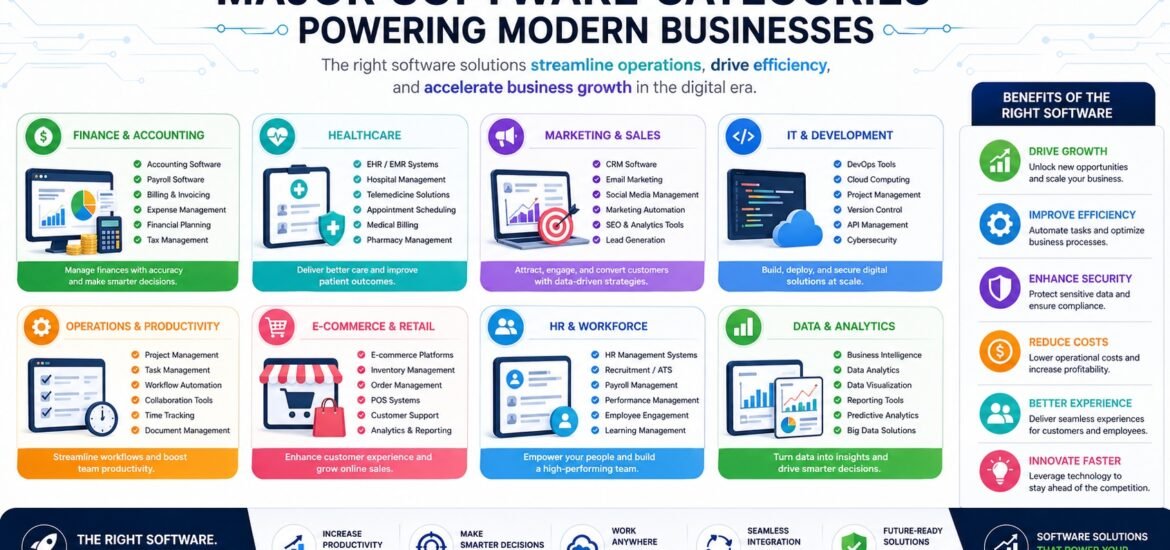
Softwares: A Complete Guide to Every Major Software Category for Modern Businesses
Software is no longer a department within a business. It is the connective tissue that runs through every part of how organisations operate, communicate, sell, manufacture, learn, and grow. From the moment a customer first hears about a brand to the final stages of order delivery, software shapes the experience. This page is designed as a clear, structured guide to the major software categories that matter today, organised in a way that helps you understand what each type does, who it serves, and where it fits within the wider technology landscape.
Whether you are a business owner exploring tools for the first time, a manager comparing options, or a curious reader trying to make sense of the software ecosystem, you will find every important category set out below in plain language. Each section explains the role of the software, the problems it solves, and the kinds of organisations that typically rely on it.
🏢 1. Business & Finance Software
Business and finance software underpins the way money moves through an organisation. From the smallest sole trader to global enterprises, these tools record transactions, manage compliance, and provide the financial visibility leaders need to make confident decisions. Below are the core types every modern business should know about.
Banking Software
Banking software powers the daily operations of banks, credit unions, and other financial institutions. It manages accounts, processes transactions, handles regulatory reporting, and connects with payment networks. Modern banking platforms also support mobile banking, fraud detection, and open banking integrations that let third parties build on top of core financial services.
Accounting Software
Accounting software records, classifies, and reports on financial transactions. It replaces traditional ledgers with cloud based dashboards that handle bookkeeping, bank reconciliation, VAT submissions, and year end reporting. Small businesses use it to stay compliant, while larger firms rely on it for real time insight into cash flow and profitability.
Financial Management Software
Financial management software goes beyond bookkeeping to support budgeting, forecasting, treasury, and corporate planning. It is typically used by finance teams in mid sized and large organisations to model scenarios, monitor performance against targets, and align financial strategy with operational reality.
Payroll Software
Payroll software calculates employee wages, tax deductions, pensions, and statutory payments. It automates payslip generation, integrates with HMRC and similar tax authorities, and ensures employees are paid accurately and on time. For UK businesses, modern payroll tools also handle Real Time Information submissions seamlessly.
Tax Preparation Software
Tax preparation software simplifies the process of calculating, filing, and paying personal and business taxes. It guides users through forms, applies relevant allowances, and submits returns electronically. Accountants and individual taxpayers alike depend on it to reduce errors and meet deadlines.
Billing & Invoicing Software
Billing and invoicing software helps businesses create professional invoices, track payments, and chase overdue accounts. It supports recurring billing for subscription based companies and integrates with accounting platforms to keep records synchronised. Faster invoicing usually translates directly into healthier cash flow.
Expense Management Software
Expense management software automates the capture, approval, and reimbursement of employee expenses. Receipts can be photographed and uploaded, policies are applied automatically, and finance teams gain visibility over spending patterns. It saves significant time compared with manual spreadsheets and paper claims.
ERP (Enterprise Resource Planning) Software
ERP software integrates core business processes such as finance, procurement, manufacturing, supply chain, and human resources into a single unified system. Large organisations use ERP to eliminate data silos, standardise workflows, and provide leadership with a single source of truth across departments.
Investment Management Software
Investment management software supports portfolio managers, wealth advisers, and individual investors in tracking holdings, analysing performance, and managing risk. It typically includes market data feeds, reporting dashboards, and compliance tools that ensure investment decisions stay within regulatory boundaries.
🏥 2. Healthcare Software
Healthcare software is among the most consequential technology used today, supporting clinicians, administrators, and patients across hospitals, clinics, and community settings. These tools improve patient outcomes, reduce errors, and bring greater efficiency to a sector under constant pressure.
Electronic Health Records (EHR) Software
EHR software stores and manages comprehensive patient medical histories in digital form. It enables clinicians to access records securely, share information across care settings, and reduce duplication of tests. Modern EHR systems also support clinical decision support and integration with diagnostic devices.
Hospital Management Software
Hospital management software coordinates the administrative and operational side of healthcare facilities. It handles admissions, bed management, billing, staff rotas, and inventory of medical supplies, allowing hospitals to deliver care more efficiently while maintaining compliance with health regulations.
Medical Billing Software
Medical billing software automates the complex process of coding clinical services, submitting claims to insurers or public health bodies, and reconciling payments. It reduces administrative burden on clinical staff and ensures providers are paid accurately for the services they deliver.
Telemedicine Software
Telemedicine software enables remote consultations between patients and clinicians through secure video, messaging, and file sharing. It expands access to care for patients in rural areas, supports follow up appointments, and has become a permanent feature of modern healthcare delivery since the pandemic accelerated its adoption.
Pharmacy Management Software
Pharmacy management software supports prescription processing, stock control, patient records, and dispensing workflows in community and hospital pharmacies. It checks for drug interactions, manages controlled substances, and helps pharmacists deliver safer, faster service.
Appointment Scheduling Software
Appointment scheduling software allows patients to book, reschedule, or cancel appointments online. It integrates with clinician calendars, sends automated reminders to reduce no shows, and frees up reception staff from repetitive phone bookings.
Health Monitoring Software
Health monitoring software collects and analyses data from wearable devices, home sensors, and patient self reports. It supports remote chronic disease management, post operative recovery tracking, and preventative care, alerting clinicians when readings fall outside expected ranges.
Laboratory Information Management Systems (LIMS)
LIMS software manages the workflow of laboratories handling clinical, research, or quality control samples. It tracks specimens from collection through analysis to reporting, ensuring accuracy, traceability, and compliance with strict laboratory standards.
🛒 3. E-commerce & Retail Software
E commerce and retail software powers the modern shopping experience, both online and on the high street. These platforms allow merchants to sell, manage inventory, fulfil orders, and serve customers across multiple channels seamlessly.
E-commerce Platforms
E commerce platforms provide everything a business needs to sell products or services online, including product catalogues, payment processing, shopping carts, and customer accounts. Popular options range from hosted services suited to beginners to flexible open source solutions favoured by larger retailers.
Inventory Management Software
Inventory management software tracks stock levels, movements, and reorder points across one or many locations. It prevents stockouts and overstocking, integrates with e commerce stores and accounting systems, and gives retailers a clear picture of what they own and where it is.
Point of Sale (POS) Software
POS software powers the checkout process in physical retail and hospitality settings. It records sales, accepts multiple payment methods, manages discounts and loyalty schemes, and synchronises data with back office inventory and accounting systems.
Order Management Software
Order management software centralises orders from multiple sales channels into a single system, routing them to the most appropriate fulfilment location. It is essential for retailers selling across websites, marketplaces, and physical stores who need consistent customer experiences regardless of where the order originated.
Retail Management Software
Retail management software combines POS, inventory, customer data, and reporting into an integrated platform tailored for shops and chains. It gives retailers visibility across all stores and supports decisions on pricing, promotions, and product mix.
Warehouse Management Software
Warehouse management software optimises the movement of goods within storage facilities. It directs picking, packing, and putaway, manages locations and bin allocations, and integrates with shipping carriers to ensure accurate and timely fulfilment.
Dropshipping Software
Dropshipping software connects online merchants with suppliers who ship products directly to customers. It automates product imports, order forwarding, and inventory synchronisation, allowing entrepreneurs to run e commerce businesses without holding their own stock.
📈 4. Marketing & SEO Software
Marketing and SEO software gives businesses the tools to attract, engage, and convert audiences in an increasingly competitive digital landscape. From research to execution to measurement, these platforms shape how brands grow online.
SEO Software
SEO software helps marketers analyse and improve a website’s visibility in search engines. It supports technical audits, on page optimisation, backlink analysis, and rank tracking, giving teams the data they need to compete for organic traffic.
Keyword Research Tools
Keyword research tools reveal the terms people actually type into search engines, along with metrics such as search volume, difficulty, and intent. They form the foundation of any serious content or SEO strategy by ensuring effort is directed where audience demand exists.
Content Marketing Software
Content marketing software supports the planning, creation, distribution, and measurement of branded content. It helps teams maintain editorial calendars, collaborate on drafts, optimise pieces for search, and track how content contributes to leads and revenue.
Social Media Management Tools
Social media management tools allow brands to schedule posts, monitor mentions, engage with followers, and analyse performance across multiple platforms from a single dashboard. They make it possible to run a consistent social presence without juggling individual native apps.
Email Marketing Software
Email marketing software manages subscriber lists, designs campaigns, and tracks opens, clicks, and conversions. Despite the rise of newer channels, email continues to deliver some of the highest returns in digital marketing, making this category a staple of most marketing stacks.
Marketing Automation Software
Marketing automation software triggers personalised messages and workflows based on user behaviour. It nurtures leads, segments audiences, and aligns marketing activity with sales pipelines, helping businesses scale their efforts without scaling headcount proportionally.
Conversion Rate Optimization Tools
CRO tools help marketers understand why visitors do or do not take desired actions on a website. Through heatmaps, session recordings, A/B tests, and surveys, they uncover friction points and reveal opportunities to improve the percentage of visitors who convert into customers.
Analytics Software
Analytics software measures and interprets user behaviour across websites, apps, and marketing channels. It transforms raw data into actionable insight, enabling teams to understand what works, what does not, and where to invest resources next.
🧑💻 5. IT & Development Software
IT and development software is the toolkit that builders use to create, deploy, and operate the digital products and services everyone else depends on. These platforms shape the speed, quality, and reliability of modern software delivery.
Website Development Platforms
Website development platforms provide the environments and frameworks needed to design, build, and launch websites. They range from drag and drop builders aimed at beginners to sophisticated platforms used by agencies and enterprise teams to deliver complex digital experiences.
CMS (Content Management Systems)
A CMS allows non technical users to create, edit, and publish website content without writing code. It separates content from design, supports user roles and workflows, and powers everything from personal blogs to multinational corporate sites.
DevOps Tools
DevOps tools bring software development and IT operations closer together. They automate building, testing, and deploying code, support continuous integration and delivery pipelines, and help teams ship reliable software faster while maintaining stability.
Version Control Systems
Version control systems track changes to code over time, allowing developers to collaborate without overwriting each other’s work. They preserve a complete history of every change, support branching for parallel development, and underpin almost all modern software engineering.
API Management Software
API management software helps organisations design, publish, secure, and monitor application programming interfaces. It governs how internal and external developers consume APIs, enforces rate limits and security policies, and turns APIs into reliable digital products in their own right.
Cloud Computing Software
Cloud computing software delivers on demand access to servers, storage, databases, and applications over the internet. It removes the need to maintain physical infrastructure, supports rapid scaling, and underpins most modern digital businesses, from startups to global enterprises.
Database Management Systems
Database management systems store, organise, and retrieve structured and unstructured data. They power the backend of virtually every digital application, from simple websites to complex enterprise platforms, and come in many forms including relational, document, graph, and time series models.
Low-Code / No-Code Platforms
Low code and no code platforms allow people without traditional programming skills to build functional applications through visual interfaces. They accelerate digital projects, empower business users to solve their own problems, and reduce the burden on overstretched IT teams.
🏗️ 6. Project & Productivity Software
Project and productivity software helps teams plan their work, coordinate their efforts, and complete what they set out to do. As remote and hybrid working have become normal, these tools have moved from useful extras to essential infrastructure.
Project Management Software
Project management software helps teams plan, execute, and monitor projects from start to finish. It supports task assignment, dependencies, deadlines, resource management, and reporting, giving project managers the visibility they need to deliver on time and within budget.
Task Management Tools
Task management tools focus on the day to day flow of individual and team tasks. They allow users to create lists, set priorities, attach files, and update status, making it easier to keep work moving without losing track of details.
Time Tracking Software
Time tracking software records how individuals and teams spend their working hours. It supports billing for service businesses, reveals where time is genuinely going, and provides data that helps leaders refine resource planning and project estimation.
Collaboration Software
Collaboration software brings teams together across locations through shared workspaces, messaging, video calls, and document collaboration. It has reshaped how organisations communicate and is now central to both remote and office based working.
Document Management Systems
Document management systems centralise the storage, organisation, and retrieval of business documents. They support version control, access permissions, and audit trails, replacing chaotic file shares with a structured, searchable single source of truth.
Workflow Automation Software
Workflow automation software replaces manual handoffs with structured, repeatable processes. It connects different tools, applies business rules, and ensures that work moves consistently between people and systems without falling through the cracks.
Note-taking Apps
Note taking apps help individuals and teams capture ideas, meeting minutes, and reference material in a searchable, organised way. Modern apps support rich media, cross device synchronisation, and collaborative editing, turning loose notes into structured personal and team knowledge.
🎓 7. Education & Learning Software
Education and learning software supports teaching, training, and skill development across schools, universities, and workplaces. These tools shape how knowledge is delivered, assessed, and certified in an increasingly digital world.
Learning Management Systems (LMS)
An LMS delivers, tracks, and manages learning experiences. Schools, universities, and corporate trainers use it to host courses, deliver assessments, track learner progress, and issue completion records, providing a structured backbone for both formal education and workplace training.
E-learning Platforms
E learning platforms host online courses available to a wide audience, often combining video lessons, quizzes, discussions, and certificates. They support both consumer learning marketplaces and dedicated platforms for organisations training their workforce or selling expertise.
Student Information Systems
Student information systems manage the administrative side of education, including admissions, enrolments, attendance, grades, and financial records. They give schools, colleges, and universities a central place to manage every aspect of a learner’s journey.
Online Course Software
Online course software allows individual creators and small businesses to build, market, and sell their own courses. It typically includes content hosting, payment processing, student dashboards, and certificate generation, enabling subject experts to monetise knowledge directly.
Virtual Classroom Software
Virtual classroom software recreates the live teaching experience in a digital environment. It supports video lectures, interactive whiteboards, breakout rooms, and real time engagement tools, making remote and hybrid education genuinely interactive rather than purely passive.
🚚 8. Logistics & Transportation Software
Logistics and transportation software keeps goods moving across cities, countries, and continents. As supply chains become more complex and customer expectations rise, these tools provide the visibility and coordination that modern commerce depends on.
Fleet Management Software
Fleet management software helps organisations oversee their vehicles, drivers, and operating costs. It tracks location, monitors fuel usage, schedules maintenance, and supports compliance with driver hours and safety regulations, improving efficiency and reducing risk across vehicle fleets of any size.
Supply Chain Management Software
Supply chain management software coordinates the flow of goods, information, and finances from raw materials to end customers. It supports demand planning, supplier management, logistics, and inventory across the entire chain, helping businesses respond to disruption and meet customer expectations.
Delivery Tracking Software
Delivery tracking software gives businesses and customers real time visibility into shipments. It updates locations, predicts arrival times, and sends notifications, reducing the volume of customer service enquiries and improving the post purchase experience.
Route Optimization Software
Route optimisation software calculates the most efficient driving routes for fleets, taking into account distance, traffic, vehicle capacity, time windows, and driver constraints. It saves fuel, reduces emissions, and increases the number of stops a single driver can complete in a working day.
Logistics Management Systems
Logistics management systems integrate the planning, execution, and monitoring of freight movements. They coordinate carriers, customs documentation, warehouse handoffs, and reporting, providing the operational backbone for businesses that move significant volumes of goods.
🏭 9. Manufacturing & Industrial Software
Manufacturing and industrial software supports the design, production, and quality control of physical goods. These platforms bring discipline and visibility to operations where small inefficiencies multiply quickly across thousands of units.
Manufacturing Execution Systems (MES)
MES software connects the shop floor to enterprise systems, capturing production data in real time. It tracks work orders, machine performance, quality checks, and operator activity, helping manufacturers improve throughput, reduce waste, and respond faster to operational issues.
Production Planning Software
Production planning software schedules manufacturing activities to match demand, capacity, and material availability. It balances customer commitments with shop floor realities, ensuring orders are completed on time without overloading equipment or staff.
Quality Management Software
Quality management software supports the inspection, documentation, and continuous improvement of product quality. It manages standards, audits, non conformances, and corrective actions, helping organisations meet certifications such as ISO 9001 while reducing the costs of poor quality.
Inventory Control Systems
Inventory control systems in manufacturing track raw materials, work in progress, and finished goods. They support demand forecasting, reorder management, and accurate valuation, ensuring the right materials are available at the right time without tying up excess capital in stock.
CAD/CAM Software
CAD and CAM software enable engineers and designers to create digital models of products and translate them into instructions for manufacturing equipment. They are essential across industries ranging from automotive and aerospace to consumer goods and architecture.
🏡 10. Real Estate Software
Real estate software supports the people and businesses involved in buying, selling, letting, and managing property. From a single landlord with one rental to large agency networks, these tools bring structure to a sector built on relationships and detail.
Property Management Software
Property management software helps landlords and managing agents handle tenancies, maintenance, rent collection, and compliance. It centralises documents, automates routine communications, and provides clear oversight of portfolios ranging from a handful of units to thousands.
Real Estate CRM
A real estate CRM manages relationships with buyers, sellers, landlords, and tenants. It tracks enquiries, viewings, offers, and pipeline, helping agents stay organised and responsive in a market where speed and personal service often determine who wins the deal.
Listing Management Software
Listing management software helps agents publish, update, and syndicate property listings across multiple portals. It saves time, reduces errors, and ensures consistency across the various channels where prospective buyers and tenants begin their search.
Rental Management Systems
Rental management systems focus specifically on the lifecycle of rental properties, from advertising and tenant screening to lease management and renewal. They are widely used by build to rent operators, student accommodation providers, and traditional landlords alike.
🔐 11. Security Software
Security software protects the digital systems, data, and identities that organisations and individuals depend on. As threats grow more sophisticated, these tools have become a non negotiable part of any responsible technology strategy.
Cybersecurity Software
Cybersecurity software defends networks, devices, and applications against unauthorised access, malware, and data breaches. It includes endpoint protection, intrusion detection, threat intelligence, and incident response tools, forming a layered defence rather than a single product.
Antivirus Software
Antivirus software detects, quarantines, and removes malicious programs from computers and mobile devices. Modern antivirus tools combine traditional signature based detection with behavioural analysis, protecting users from both well known threats and newer variants.
Firewall Software
Firewall software controls incoming and outgoing network traffic according to defined security rules. It acts as the gatekeeper between trusted internal networks and the wider internet, blocking unwanted connections and limiting the spread of attacks if they occur.
Identity & Access Management (IAM)
IAM software ensures that the right people have the right access to the right systems at the right time. It manages authentication, single sign on, multi factor verification, and role based permissions, reducing the risk of compromised credentials being misused.
Encryption Software
Encryption software scrambles data so that only authorised parties can read it. It protects information at rest on devices and servers and in transit across networks, providing a critical layer of defence even when other security controls fail.
🎮 12. Media & Entertainment Software
Media and entertainment software powers the creation, distribution, and enjoyment of the content that defines modern culture. From independent creators to major studios, these tools shape what audiences see, hear, and play.
Video Editing Software
Video editing software allows creators to assemble, refine, and finish video content. It supports cutting, transitions, colour grading, audio mixing, and visual effects, with options ranging from beginner friendly apps to professional suites used in broadcast and film.
Audio Editing Software
Audio editing software enables musicians, podcasters, and sound designers to record, edit, and produce audio. It handles multi track mixing, noise reduction, mastering, and export to a wide range of formats, supporting both creative work and technical post production.
Streaming Platforms
Streaming platforms deliver video, audio, and live content to audiences over the internet. They handle encoding, content protection, subscriptions, and recommendations, and have transformed how people consume entertainment, news, and educational material worldwide.
Animation Software
Animation software supports the creation of 2D and 3D animated content for film, television, advertising, and games. It covers everything from simple motion graphics to complex character animation, providing the tools that bring imagined worlds to life.
Game Development Software
Game development software gives studios and independent creators the engines and tools needed to build interactive experiences. It supports graphics, physics, audio, scripting, and multiplayer networking, powering everything from mobile titles to AAA console releases.
🧾 13. Legal & Compliance Software
Legal and compliance software helps organisations manage risk, contracts, and regulatory obligations. As legal landscapes grow more complex, these tools bring order, traceability, and efficiency to work that was once dominated by paperwork.
Legal Case Management Software
Legal case management software helps law firms and in house teams organise cases, deadlines, documents, and client communications. It improves productivity, reduces missed deadlines, and provides a single secure place where every detail of a matter can be found.
Contract Management Software
Contract management software supports the full lifecycle of agreements from drafting and negotiation through signature and renewal. It centralises templates, tracks obligations, and provides visibility over commitments that would otherwise be scattered across email and shared drives.
Compliance Management Software
Compliance management software helps organisations track, document, and demonstrate adherence to laws, regulations, and internal policies. It supports audits, risk assessments, and training, reducing both the cost and the anxiety of meeting complex regulatory requirements.
Document Automation Software
Document automation software generates customised documents from templates and structured data. It is widely used in legal, financial, and HR contexts where the same types of documents are produced repeatedly with variations, saving time and improving consistency.
🚗 14. Automotive Software
Automotive software supports the way vehicles are managed, maintained, and used. From individual drivers to large fleets, these tools bring data and intelligence to an industry undergoing rapid transformation.
Vehicle Management Software
Vehicle management software helps owners and operators track maintenance schedules, mileage, costs, and documentation for cars, vans, or specialised vehicles. It is used by individuals managing personal cars and by businesses overseeing pool vehicles or company cars.
Fleet Tracking Systems
Fleet tracking systems use GPS and telematics to monitor vehicle location, driver behaviour, and operating performance in real time. They support efficiency, safety, and customer service across delivery, service, and passenger transport businesses.
Automotive Diagnostic Software
Automotive diagnostic software interprets data from a vehicle’s onboard systems to identify faults and performance issues. It is used by mechanics, dealers, and increasingly by enthusiasts to diagnose problems faster and more accurately than traditional methods allow.
Ride-sharing Platforms
Ride sharing platforms connect passengers with drivers through smartphone apps, handling booking, routing, payment, and ratings. They have reshaped urban transport in many cities and continue to evolve into broader mobility services that include scooters, bikes, and public transport integration.
🧠 15. AI & Data Software
AI and data software is reshaping how organisations make decisions, automate work, and create new products. From traditional analytics to cutting edge machine learning, these tools turn raw information into competitive advantage.
AI Development Platforms
AI development platforms provide the infrastructure and tooling needed to build, train, and deploy artificial intelligence models. They support data preparation, experiment tracking, model serving, and monitoring, helping organisations move from prototypes to reliable production systems.
Machine Learning Software
Machine learning software allows data scientists and engineers to build models that learn patterns from data. It is used to power recommendations, fraud detection, demand forecasting, and a growing range of other applications across virtually every industry.
Data Analytics Software
Data analytics software helps organisations explore, transform, and interpret data to support decisions. It includes self service tools used by business analysts as well as more advanced platforms used by specialist data teams to surface deeper insights.
Business Intelligence (BI) Tools
BI tools transform data from multiple sources into dashboards, reports, and visualisations that leaders can act on. They give organisations a shared view of performance and turn what was once gut feel decision making into evidence based management.
Big Data Platforms
Big data platforms store and process the vast volumes of structured and unstructured data generated by modern systems. They underpin everything from genomic research to global e commerce analytics, providing the scale that traditional databases simply cannot offer.
🌐 16. Communication Software
Communication software keeps people connected across teams, time zones, and channels. Whether the conversation is internal, with customers, or across global partners, these tools shape the speed and quality of every interaction.
Video Conferencing Software
Video conferencing software supports face to face meetings between people in different locations. It includes screen sharing, recording, and collaboration features that have made it a permanent part of working life rather than a temporary substitute for the office.
Messaging Apps
Messaging apps provide fast, informal communication between individuals and teams. They have largely replaced internal email for short interactions and increasingly serve as the front line of customer service for businesses meeting customers in the channels they already use.
VoIP Software
VoIP software delivers voice calls over the internet rather than traditional telephone networks. It reduces costs, supports flexible working, and integrates with CRM and helpdesk systems to make every conversation more productive.
Customer Communication Platforms
Customer communication platforms unify the various channels through which businesses interact with customers, including chat, email, social media, and SMS. They provide agents with full context and ensure customers receive consistent service regardless of how they make contact.
🧑💼 17. HR & Recruitment Software
HR and recruitment software supports the people side of every organisation, from attracting new talent to developing existing teams. These tools make people processes more consistent, transparent, and effective.
Human Resource Management Systems (HRMS)
An HRMS centralises core HR functions such as employee records, leave, payroll integration, and policy management. It gives HR teams the data and workflows they need to run efficiently while providing employees with self service access to their own information.
Applicant Tracking Systems (ATS)
An ATS manages the recruitment pipeline from job posting through application, interview, and offer. It keeps candidates moving through structured processes, supports collaboration between hiring managers, and provides data on what is working in your recruitment efforts.
Employee Engagement Software
Employee engagement software gathers feedback, measures sentiment, and supports the kind of conversations that improve workplace culture. It helps leaders understand how their people genuinely feel and respond before small concerns become serious retention problems.
Performance Management Tools
Performance management tools support goal setting, regular check ins, feedback, and formal reviews. They replace once a year appraisals with continuous, structured conversations that help employees grow and align their work with wider organisational priorities.
💡 18. Emerging Softwares
Emerging software categories reflect how work, business, and culture are changing. These are the platforms gaining significant traction now and shaping how organisations will operate over the next decade.
Exhibition Management Software
Exhibition management software supports the planning and running of trade shows, conferences, and exhibitions. It handles exhibitor registration, floor plans, badge printing, lead capture, and post event analytics, bringing structure to events that involve thousands of moving parts.
Event Management Software
Event management software supports the full lifecycle of events from planning and registration to delivery and follow up. It serves corporate event teams, agencies, and venues, helping them deliver memorable experiences while keeping budgets and logistics under control.
Influencer Marketing Platforms
Influencer marketing platforms connect brands with content creators across social media. They support discovery, contracting, content approval, and performance measurement, professionalising what was once a fragmented and informal channel into a measurable marketing discipline.
Subscription Management Software
Subscription management software handles recurring billing, renewals, upgrades, and cancellations for businesses with subscription models. It supports the metrics that matter in this space, including churn, lifetime value, and recurring revenue, and is essential for any business charging customers on an ongoing basis.
Creator Economy Tools
Creator economy tools help individual creators build, monetise, and manage their audiences. They include platforms for newsletters, memberships, digital products, and direct fan support, enabling creators to operate as independent businesses without traditional intermediaries.
Remote Work Software
Remote work software brings together the tools distributed teams need to collaborate effectively. It includes virtual offices, asynchronous communication, secure access to company systems, and digital whiteboards, supporting a way of working that is now permanent for many organisations.
Sustainability Tracking Software
Sustainability tracking software helps organisations measure, report, and improve their environmental impact. It supports carbon accounting, ESG reporting, and supplier assessments, responding to growing pressure from regulators, investors, and customers for credible, measurable commitments.
Choosing the Right Software for Your Business
The categories above cover the technology landscape that modern organisations operate within, but choosing the right tools is rarely about picking the most popular product. The best software for your business is the one that fits the way you actually work, integrates well with the systems you already rely on, and grows with you rather than against you. As we develop dedicated pages for each of these categories, you will find deeper guidance on how to evaluate options, what to ask vendors, and where each type of software typically delivers the strongest return.
If you are unsure which category best matches a particular business challenge you are facing, the right starting point is to describe the problem in plain terms first, then look at which software category aligns with that problem. Software is most powerful when it serves a clearly defined purpose, and least useful when it is bought because it sounds impressive. Use this page as your map, and let the specific category pages guide your detailed decisions.