
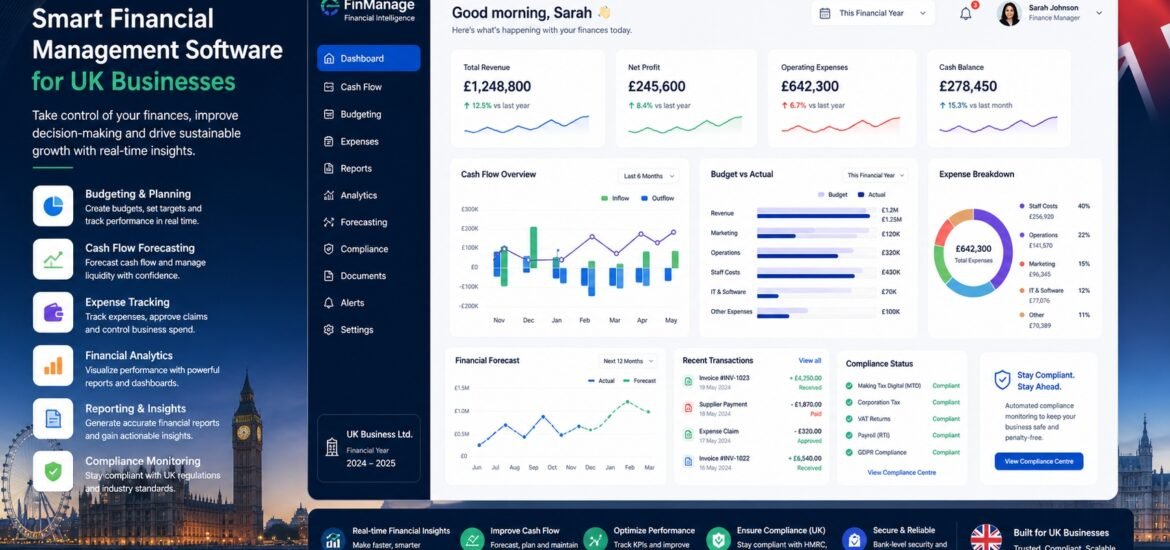
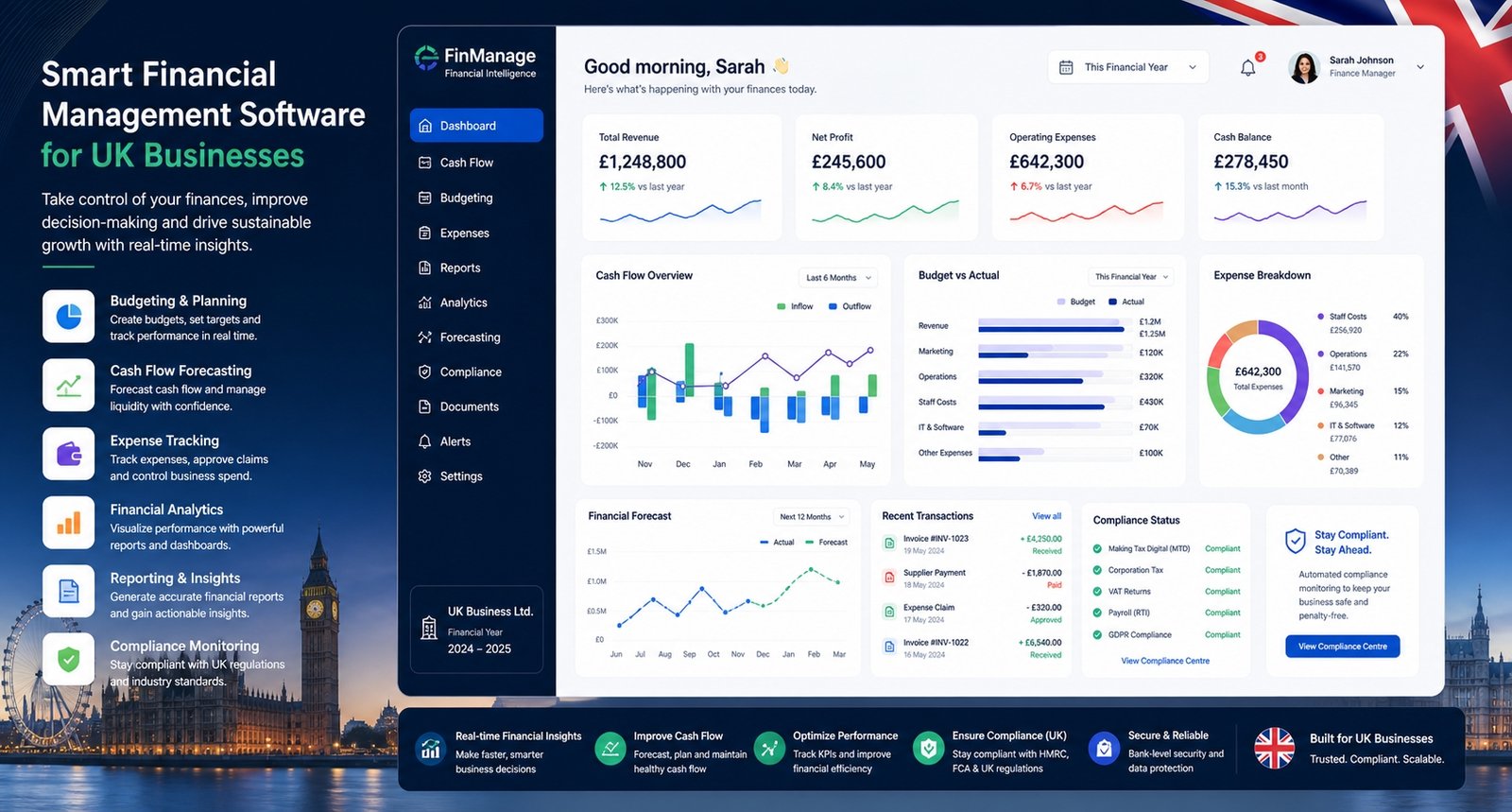
A practical guide to financial management software for UK businesses, covering budgeting, cash flow forecasting, reporting tools, compliance requirements, and expert tips to improve financial performance and decision-making.
Financial Management Software: A Complete Guide for UK Businesses
Where accounting software records what has happened, financial management software helps leaders decide what should happen next. It is the layer of finance technology that supports budgeting, forecasting, scenario planning, group consolidation, and the kind of reporting that boards, investors, and lenders expect from any serious UK organisation. For finance directors and CFOs, it is often the difference between presenting numbers and shaping strategy.
This guide explains what financial management software is, the main types available, the UK specific considerations that shape platform choice, and how to know when your business has outgrown its accounting platform and is ready for something more strategic. It is written for a British audience and addresses the regulatory, operational, and governance realities of running a finance function in the UK in 2026.
Accounting tells you the score at the end of the game. Financial management software tells you whether you are about to win, lose, or run out of time before the final whistle.
What Is Financial Management Software?
Financial management software is the family of platforms that supports the planning, analysis, and strategic oversight of an organisation’s finances. Where accounting software focuses on recording transactions and producing statutory outputs, financial management software focuses on what those transactions mean for the future. It supports budgeting and forecasting, multi entity consolidation, performance reporting, treasury and cash flow management, and the kind of decision support that finance teams provide to the wider business.
For some organisations, this is a single integrated platform sitting above the accounting system. For others, it is a stack of specialist tools, each addressing a particular need. Either way, the purpose is the same: to turn financial data into insight, and insight into better decisions.
Why Financial Management Software Matters in the UK Today
The expectations placed on UK finance functions have grown significantly over the past decade. Boards expect rolling forecasts rather than annual budgets revisited once a year. Investors and lenders expect timely, accurate consolidated reporting across multiple entities and currencies. Auditors expect detailed audit trails and traceable supporting workings. Regulators expect climate and ESG disclosures alongside traditional financial statements. Customers and employees expect businesses to navigate inflation, energy volatility, and shifting demand without missing a beat.
Spreadsheets, no matter how skilfully built, struggle under this weight. Errors compound, version control becomes impossible, and the time spent chasing numbers leaves little for actually analysing them. Modern financial management software addresses these problems directly. It provides a single, controlled environment for plans and forecasts, integrates with accounting and operational systems for real time data, and frees finance teams from production work so they can spend more time on the analysis and advice that genuinely shapes the business.
The result is that financial management software has moved from being a luxury for large corporates to a practical necessity for any UK organisation that has outgrown the limits of its accounting platform.
Quick Navigation
Use the links below to jump straight to any section of this guide.
- Core Capabilities of Financial Management Software
- Types of Financial Management Software
- Who Uses Financial Management Software
- Key Features of Modern Platforms
- UK Specific Considerations
- Financial Management vs Accounting Software
- When to Move from Accounting to Financial Management
- How It Connects to the Wider Finance Stack
- Comparison Table
- How to Choose Financial Management Software
- Common Questions
Core Capabilities of Financial Management Software
Although platforms differ in scope and sophistication, most financial management software shares a common set of foundational capabilities that distinguish it from basic accounting tools.
Planning and forecasting
The ability to build budgets, forecasts, and longer term plans across the whole organisation is the heart of financial management software. Plans can be built bottom up by department, top down by finance, or both, with the system reconciling the two. Rolling forecasts can be updated continuously rather than once a year.
Scenario modelling
Modern platforms allow finance teams to model the impact of different assumptions on the business. What happens to cash flow if revenue grows fifteen percent slower than planned? What happens to margin if energy costs rise twenty percent? Scenario modelling turns these questions from spreadsheet projects into routine analysis.
Consolidation
For UK businesses with multiple legal entities, consolidation software brings together separate sets of accounts into a single group view, handling intercompany eliminations, foreign currency translation, and the accounting standards required for the group’s reporting framework.
Reporting and dashboards
Standard financial reports such as profit and loss, balance sheet, and cash flow are produced on demand, alongside management dashboards that turn the underlying data into visual summaries. The best platforms give different audiences, from the CFO to a department head, views that fit their specific information needs.
Workflow and collaboration
Financial management software supports the human side of finance work too. Budget submissions, forecast updates, approvals, and queries flow through structured workflows rather than getting lost in email threads, with full visibility for finance teams over where everything stands.
Integration with source systems
Reliable financial management depends on reliable data. Modern platforms integrate with accounting systems, ERP, CRM, payroll, and operational tools to draw in actuals automatically rather than requiring manual exports and rekeying.
Types of Financial Management Software
Within the broad category of financial management software sit several distinct types, each addressing particular needs. The eight most important are explored below.
1. Budgeting and Forecasting Software
Budgeting and forecasting software replaces the annual spreadsheet ritual with a controlled, collaborative process. Departments submit budgets through structured templates, finance reviews and challenges them within the system, and the resulting plan is locked down and tracked against actuals throughout the year. Rolling forecasts then update the view of where the business is heading as new actual data flows in.
For UK businesses, the value of moving budgeting out of spreadsheets goes beyond efficiency. It produces a single source of truth, eliminates the version control nightmare of dozens of files circulating by email, and gives finance the time and confidence to engage in real conversations about the numbers rather than fixing them.
2. Financial Planning and Analysis (FP&A) Software
FP&A software extends budgeting and forecasting into a fuller analytical capability. It supports variance analysis, driver based modelling, profitability analysis by product or customer, and the strategic planning conversations that finance teams have with the rest of the business. For mid sized and larger UK organisations, FP&A is increasingly seen as the central nervous system of the finance function.
Modern FP&A platforms emphasise self service for business users, built in version control, and the kind of dashboards that turn finance from a producer of monthly packs into a live partner to the business. They typically integrate tightly with accounting, ERP, and operational data sources.
3. Consolidation and Close Software
Consolidation and close software supports the production of consolidated group accounts and the management of the financial close process. For UK groups with multiple subsidiaries, joint ventures, or international operations, it handles intercompany eliminations, currency translation, and the application of accounting standards across entities.
Close management capabilities help finance teams shorten the time it takes to produce reliable monthly, quarterly, and annual numbers. Tasks are tracked through structured checklists, journal approvals are documented, reconciliations are automated, and the overall close timeline becomes visible and improvable rather than a black box that the finance team disappears into for the first ten days of every month.
4. Treasury Management Software
Treasury management software supports the management of cash, debt, investments, and financial risk. For UK businesses, it brings together balances across multiple bank accounts, supports cash forecasting, manages debt and facility utilisation, handles foreign exchange exposure, and provides the controls needed to prevent fraud and error in payment processes.
Although smaller businesses can manage these functions through accounting software and bank portals alone, larger and more international organisations almost always reach a point where dedicated treasury software becomes essential. The category overlaps with bank provided treasury services and with broader financial management platforms that include treasury modules.
5. Cash Flow Management Software
Cash flow management software focuses specifically on the movement of money in and out of a business. It produces short term cash forecasts, often at thirteen weeks, by combining accounting data with payment patterns and forward commitments. For UK SMEs in particular, the rise of dedicated cash flow tools reflects how often even profitable businesses get into trouble through poor cash visibility.
The best cash flow tools integrate with accounting software through bank feeds and accounts receivable and payable data, then add forward looking modelling that the underlying accounting platform does not provide on its own. They are increasingly seen as essential rather than optional, particularly for businesses with seasonal revenue, long collection cycles, or significant capital expenditure.
6. Performance Management and Reporting Software
Performance management software focuses on producing structured management reporting and tracking key performance indicators. It typically draws data from accounting, ERP, CRM, and operational systems and presents it through dashboards and standard reports tailored to the needs of different audiences within the business.
Where general business intelligence tools are designed for any kind of analysis, performance management software is shaped specifically around financial and operational performance, with built in support for variance analysis, trend analysis, and the typical structures of financial reporting. UK organisations often deploy it to support board reporting, divisional management packs, and the rhythm of regular performance reviews.
7. Risk and Compliance Management Software
Risk and compliance management software supports the identification, assessment, and reporting of financial and operational risks. It maintains risk registers, supports control testing, manages compliance with regulatory frameworks, and produces the documentation that audit committees and regulators expect.
For UK businesses, this category has grown in importance with the expansion of governance expectations under the UK Corporate Governance Code, internal controls reporting, climate and ESG disclosures, and sector specific regulatory regimes. Although it overlaps with broader governance, risk, and compliance tools, financial focused risk and compliance software is often deployed within or alongside the finance function.
8. Corporate Performance Management (CPM) Suites
Corporate performance management suites bring together the various financial management capabilities described above into a single integrated platform. A typical CPM suite covers budgeting and forecasting, FP&A, consolidation and close, performance reporting, and increasingly strategic planning and ESG reporting as well.
For larger UK organisations, CPM suites offer the appeal of a single source of truth across the financial management lifecycle, although they also represent a significant investment and a longer implementation. Smaller organisations often achieve similar outcomes through best of breed combinations of the more specialised tools described above.
Who Uses Financial Management Software
Financial management software is used by a range of roles and organisations, with different platforms suited to different scales and structures.
- CFOs and finance directors: Use financial management software to drive planning, performance reporting, and strategic conversations with boards and shareholders.
- Financial controllers: Rely on consolidation, close, and reporting capabilities to produce accurate and timely group accounts.
- FP&A teams: Use planning and analysis platforms as their primary working environment, replacing or supplementing the spreadsheets that have traditionally dominated this function.
- Treasury teams: Use treasury management software to oversee cash, debt, foreign exchange, and counterparty risk across the organisation.
- Group finance teams: In multi entity organisations, depend on consolidation software to bring subsidiary results together into a coherent group view.
- Business unit and department heads: Engage with financial management software through self service dashboards, budget submissions, and forecast updates.
- Audit committees and boards: Are the ultimate consumers of much of the output, particularly through the management reporting and risk functions of these platforms.
- Private equity and growth investors: Often expect their portfolio companies to operate financial management software at a level of sophistication that supports investor reporting and strategic decision making.
Key Features Every Modern Financial Management Platform Should Have
Although the right software depends on the business, certain features have become baseline expectations for any modern financial management platform serving UK organisations.
- Direct integration with accounting and ERP systems for real time actuals
- Flexible budgeting and forecasting models, including driver based and rolling approaches
- Multi entity consolidation with intercompany eliminations and currency translation
- Support for UK and international accounting standards, including FRS 102 and IFRS
- Self service reporting and dashboards for non finance users
- Variance analysis between actuals, budget, and forecast
- Scenario and sensitivity modelling for strategic planning
- Workflow and approvals for budget submissions and forecast updates
- Detailed audit trails for every change to plans, forecasts, and reports
- Strong security and access controls, including role based permissions
- API access and integration with business intelligence and analytics tools
- Cloud based deployment with appropriate resilience and disaster recovery
UK Specific Considerations for Financial Management Software
Although financial management software is broadly similar across markets, several UK specific considerations shape platform choice and configuration.
UK accounting standards
Most UK businesses report under FRS 102, with smaller companies often using FRS 105 and listed groups using IFRS. Financial management software used in the UK should support the relevant standards, including their disclosure requirements and the differences in measurement and recognition that apply.
Group structure and consolidation
UK groups frequently include holding companies, trading subsidiaries, dormant entities, and joint ventures, often across multiple jurisdictions. Consolidation tools should handle this complexity natively rather than relying on workaround logic that breaks down at year end.
Multi currency operations
Many UK businesses have international customers, suppliers, or subsidiaries. Financial management software should handle multi currency transactions, period end translation, and the resulting foreign exchange differences in line with the relevant accounting standards.
UK governance expectations
Listed companies and many large private companies operate under UK Corporate Governance Code expectations and the requirements of audit committees. Financial management software supports this through structured controls, clear audit trails, and the ability to evidence the basis of key numbers presented to the board.
Climate and ESG reporting
UK businesses face a steadily expanding set of climate and ESG reporting expectations, including TCFD aligned disclosures, mandatory greenhouse gas reporting, and emerging requirements around sustainability disclosures. Modern financial management platforms increasingly include or integrate with ESG reporting capabilities, reflecting how closely sustainability data sits to traditional financial reporting.
Audit and assurance
UK audits, whether statutory or voluntary, increasingly involve auditor access to underlying systems and data. Financial management software should provide the kind of structured records, audit trails, and reporting that allows auditors to test balances and disclosures efficiently rather than relying on extracts and reconciliations produced by the finance team.
Data protection and security
Financial management systems hold highly sensitive data, including pay information, strategic plans, and commercially confidential numbers. UK GDPR and the Data Protection Act apply to personal data within these systems, while wider security expectations apply across the board. Reputable platforms address this through encryption, access controls, and certifications such as ISO 27001 and SOC 2.
Financial Management Software vs Accounting Software
This is one of the most common areas of confusion among UK business owners, and the distinction is worth setting out clearly.
Accounting software is built around the recording of transactions and the production of statutory outputs. It tells you what has happened: how much you have invoiced, what you have paid, what your VAT liability is, and what your profit and loss looks like for the period just ended. It is essential, regulated, and the natural starting point for almost any UK business.
Financial management software is built around the planning, analysis, and reporting that sit on top of accounting data. It tells you what is likely to happen, what could happen under different assumptions, and how performance compares with the plans you set. It supports forecasting, multi entity consolidation, scenario modelling, and the kind of management reporting that goes beyond the standard accounting outputs.
The two are complementary rather than alternatives. Most UK businesses start with accounting software, add specialist tools for cash flow and reporting as they grow, and eventually adopt fuller financial management or CPM platforms as the complexity of the organisation justifies the investment. For more on the foundations, see our dedicated Accounting Software guide.
When to Move from Accounting Software to Financial Management Software
Knowing when a UK business is ready for dedicated financial management software is a question every growing organisation faces. The signals are usually clear once you know what to look for.
- Budgets and forecasts are built and maintained primarily in spreadsheets that have grown unwieldy
- Multiple legal entities or subsidiaries are being consolidated through manual workarounds at month end
- The finance team spends more time producing reports than analysing them
- Different parts of the business hold different versions of what the numbers should be
- The board or investors are asking for analysis that the current platform cannot easily produce
- Scenario planning and sensitivity analysis are difficult or impossible to do reliably
- Cash forecasting is consistently late, inaccurate, or based on best guesses
- The business is preparing for a transaction, fundraise, or significant strategic shift
- ESG and climate reporting are becoming serious requirements rather than future concerns
Hitting two or three of these signals usually justifies a serious look at financial management software. Hitting five or more usually means the question is not whether to move, but how soon and to what.
How Financial Management Software Connects to the Wider Finance Stack
Financial management software sits in the middle of the wider UK finance technology stack. Below it sit the systems of record: accounting software, ERP platforms, payroll, billing, and operational systems that produce the actual data. Above it sit the consumers of insight: boards, investors, lenders, auditors, and the various business stakeholders who need to understand financial performance.
To either side sit closely related tools. Business intelligence tools overlap with financial management reporting and are often used together. Investment management software sits alongside treasury for organisations with significant investment portfolios. Risk and compliance tools, increasingly important for UK businesses, often sit close to financial management for governance reasons.
The art of building this part of the finance stack is to choose platforms that integrate cleanly so that data flows once, automatically, between the systems of record and the layer of analysis. For a complete view of how financial management fits within the broader UK finance technology landscape, see our Business & Finance Software hub.
Comparison Table: Types of Financial Management Software at a Glance
The following table summarises the eight types of financial management software covered in this guide.
| Software Type | Primary Purpose | Typical UK User |
|---|---|---|
| Budgeting and Forecasting | Build, manage, and track plans against actuals | Finance teams across all but the smallest businesses |
| FP&A Software | Plan, analyse, and partner with the business | Mid sized and larger UK organisations |
| Consolidation and Close | Produce group accounts and run a controlled close | UK groups with multiple entities |
| Treasury Management | Manage cash, debt, FX, and financial risk | Mid sized to large UK businesses |
| Cash Flow Management | Forecast and manage short term cash | SMEs and growth businesses |
| Performance Management and Reporting | Produce structured management reporting | Finance teams supporting board level reporting |
| Risk and Compliance Management | Document, monitor, and report on risks | Larger, regulated, and listed UK organisations |
| Corporate Performance Management Suites | Integrate the full financial management lifecycle | Larger UK organisations seeking a single platform |
How to Choose Financial Management Software for a UK Business
Selecting financial management software is a strategic decision that will shape how the finance function operates for years to come. The following framework helps focus the decision on what matters most.
1. Define the problems you actually need to solve
Are you struggling with budgeting? Consolidation? Cash forecasting? Board reporting? Different platforms have different strengths, and the right starting point is a clear understanding of where current pain is concentrated rather than a search for the platform with the longest feature list.
2. Match the platform to your organisational scale and complexity
A complex CPM suite is overkill for a single entity SME. A simple cash flow tool is inadequate for a multinational group. Choose tools sized to your reality, with credible scope to grow as the business does, rather than to the most ambitious version of the company you hope to become in ten years.
3. Insist on integration with your accounting and operational systems
Financial management software lives or dies on the quality of its data feeds. Confirm that the platform integrates cleanly with your accounting system, ERP, payroll, and any other source systems that contribute to the numbers you want to manage. Manual data loads are a warning sign rather than a workaround.
4. Confirm UK regulatory and accounting fit
Whatever you choose must support the accounting standards your business reports under, the structure of your group, and the governance expectations applicable to your sector. Generic global platforms with limited UK depth often look attractive at first and frustrate at year end.
5. Involve the people who will actually use it
Financial management software is only as effective as the team using it. Involve FP&A analysts, the financial controller, and key business users in the evaluation. Software your team finds awkward will struggle to deliver value, no matter how impressive the demo looked.
6. Consider the long term total cost
Subscription fees are only one part of the picture. Implementation, configuration, training, integration, and ongoing support all matter. So does the cost of replacing the platform later if it turns out to be the wrong fit. A clear total cost view over five years is far more useful than a focus on year one numbers.
7. Plan implementation as a transformation, not an installation
Financial management software changes how the finance function works. Treat the implementation as an opportunity to redesign processes, clarify reporting structures, and improve data quality rather than simply moving existing problems into a new system. Done well, the implementation itself becomes one of the main sources of value.
Common Questions About Financial Management Software
Is financial management software the same as ERP?
No. ERP integrates the operational and financial systems of an organisation, including procurement, inventory, manufacturing, and accounting. Financial management software focuses specifically on the planning, analysis, and reporting layers above the accounting system. The two often work together, with ERP providing data that financial management software then plans, models, and reports on.
Do small UK businesses need financial management software?
Most very small UK businesses can manage with their accounting platform’s reporting tools and a thoughtful spreadsheet or two. Once a business has multiple entities, regular board reporting, significant cash management complexity, or the scale to justify a dedicated FP&A function, dedicated financial management software typically pays for itself.
How long does it take to implement financial management software?
Implementation timelines vary widely. A focused budgeting and forecasting tool for a single entity might be live in six to twelve weeks. A full CPM suite covering planning, consolidation, and reporting across a multinational group can take six to eighteen months. Realistic timelines depend on scope, data complexity, and the maturity of the underlying accounting and operational systems.
Can financial management software replace spreadsheets entirely?
For core processes such as budgeting, forecasting, consolidation, and management reporting, well implemented financial management software should largely replace spreadsheets. Ad hoc analysis, one off models, and very specific bespoke needs may still live in spreadsheets, ideally connected to the main platform rather than running parallel to it.
How much does financial management software cost in the UK?
Costs vary enormously. Lighter tools focused on cash flow, budgeting, or reporting can be available from a few hundred pounds per month. Mid market FP&A and consolidation platforms typically run from £20,000 to £100,000 per year all in. Enterprise CPM suites for large UK groups can run into hundreds of thousands of pounds annually. Implementation and integration costs are often comparable to the first year of licence fees.
Is cloud financial management software safe enough for sensitive data?
Reputable cloud platforms offer security that meets or exceeds what most organisations can implement themselves, including encryption, multi factor authentication, regular penetration testing, and certifications such as ISO 27001 and SOC 2. The bigger risks usually involve internal access controls, password discipline, and integration security rather than the cloud model itself.
How does financial management software support ESG reporting?
Modern platforms increasingly include or integrate with ESG reporting capabilities, allowing climate and sustainability data to be planned, tracked, and reported alongside traditional financial measures. Given the growing UK regulatory focus on TCFD aligned disclosures and sustainability reporting, this integration is becoming a meaningful differentiator between platforms.
Can financial management software help during fundraising or a sale?
Yes, often substantially. Buyers and investors place a significant premium on businesses that can produce timely, reliable, and well supported numbers, including detailed forecasts and clear consolidation. A well implemented financial management platform shortens due diligence, reduces the burden on the finance team during a transaction, and increases the credibility of the numbers being presented.
Final Thoughts on Financial Management Software for UK Organisations
Financial management software has moved from a specialist concern of large corporates to a practical foundation for any UK organisation that takes its finance function seriously. The platforms covered in this guide turn finance from a producer of historical statements into a partner in shaping the future, supporting the planning, analysis, and reporting that boards, investors, and operational leaders increasingly expect.
Choose carefully, with the actual problems you need to solve at the front of your mind rather than the longest feature list. Match the platform to your scale, integrate it cleanly with your accounting and operational systems, and treat the implementation as a chance to redesign how finance works rather than simply automating what you already do. Get those things right and financial management software will quietly become one of the most valuable investments your organisation makes.
For more on how financial management software fits within the broader landscape of UK business and finance technology, return to the Business & Finance Software hub. For a wider view of every software category covered on this site, visit our main Softwares hub.