
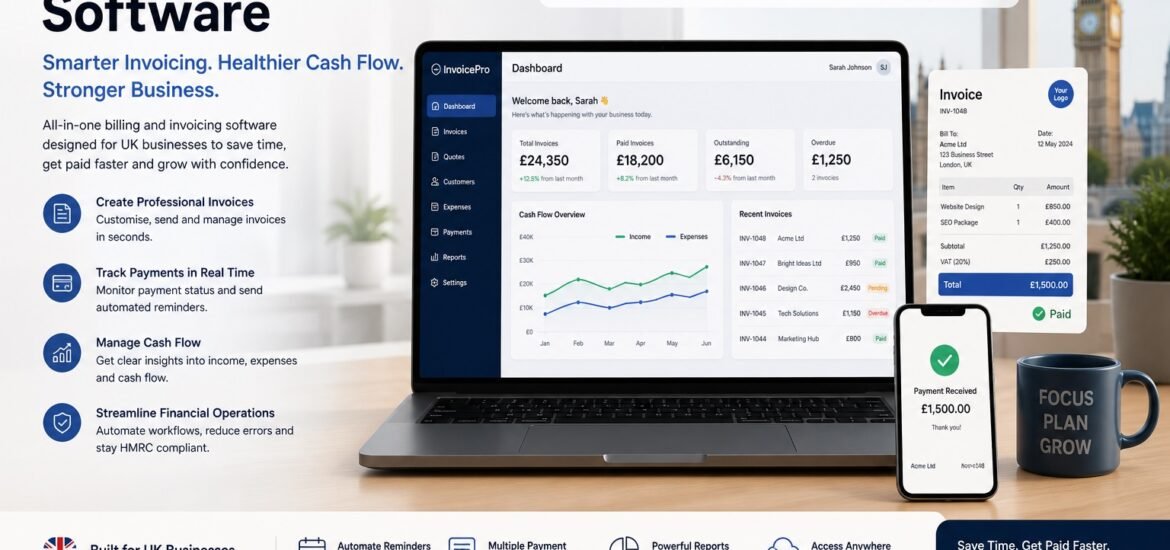
Billing and invoicing software is essential for modern UK businesses looking to streamline financial operations. This guide covers key features, benefits and how to choose the right solution to manage invoices, track payments, maintain compliance and improve overall cash flow.
Billing & Invoicing Software: A Complete Guide for UK Businesses
Cash flow is the heartbeat of every business, and billing and invoicing software is the muscle that keeps it pumping. Whether you are a freelancer raising your first invoice, an agency managing retainers, a tradesperson invoicing on a job site, or a subscription business processing thousands of recurring charges every month, the platform you use to bill your customers shapes how quickly you get paid, how professional you appear, and how cleanly your numbers flow into the rest of your finance stack.
This guide explains what billing and invoicing software is, the main types available in the UK, the regulatory and practical considerations that shape platform choice, and how to choose well for the kind of business you actually run. It is written for a British audience and addresses the realities of getting paid in the UK in 2026, where HMRC invoice rules, VAT schemes, late payment legislation, and the rise of pay by bank are all reshaping what good billing looks like.
The fastest way to improve a UK business’s cash position is rarely to chase customers harder. It is to issue better invoices, sooner, through software that makes paying you the path of least resistance.
What Is Billing & Invoicing Software?
Billing and invoicing software is the family of platforms that businesses use to create, send, track, and reconcile invoices. It replaces handwritten paper bills, generic word processed templates, and ad hoc spreadsheets with structured digital systems that handle the full lifecycle of a charge: from the work being done or product being delivered, to the invoice landing in the customer’s inbox, to the payment arriving in the bank account, to the reconciliation that closes the loop in accounting.
Modern billing and invoicing software is overwhelmingly cloud based, integrates directly with payment providers and accounting platforms, and supports a wide range of business models. For some users it is essentially a digital invoice book. For others it is a sophisticated revenue engine handling subscriptions, usage based billing, multi currency invoicing, and complex tax across many jurisdictions.
Why Billing & Invoicing Software Matters in the UK Today
Several forces have made billing and invoicing software more important to UK businesses than ever before. Late payment remains a chronic problem, particularly for SMEs supplying larger customers, and the difference between getting paid in fourteen days and forty five days can be the difference between healthy growth and a cash crisis. Customers expect to pay digitally, often by card, direct debit, or open banking instant transfer, and increasingly expect to choose their preferred method at the moment they receive the invoice.
The regulatory environment has also tightened. HMRC has clear rules about what a VAT invoice must contain. Making Tax Digital requires that invoices feed into accounting systems through digital links rather than rekeying. The construction sector reverse charge has changed the way many subcontractor invoices look. Government work increasingly expects electronic invoicing through structured formats rather than PDF attachments. And the wider direction of travel is towards e invoicing as a standard rather than an exception.
Modern billing and invoicing software addresses all of this. It produces compliant invoices, makes paying easy, integrates with the accounting and tax tools that depend on accurate billing data, and gives UK businesses the visibility they need to manage receivables actively rather than reactively.
Quick Navigation
Use the links below to jump straight to any section of this guide.
- Core Functions of Billing and Invoicing Software
- Types of Billing and Invoicing Software
- Who Uses Billing and Invoicing Software
- Key Features of Modern Platforms
- UK Specific Requirements
- Billing & Invoicing Software and Cash Flow
- Recurring Billing and the UK Subscription Economy
- How It Connects to the Wider Finance Stack
- Comparison Table
- How to Choose Billing and Invoicing Software
- Common Questions
Core Functions of Billing & Invoicing Software
Although platforms vary in scale and sophistication, most billing and invoicing software shares a common set of foundational capabilities that any UK business should expect.
Invoice creation
The software creates professional invoices using customisable templates that include your branding, contact details, terms, and the legally required content for UK invoices. Line items can be added manually or pulled from quotes, projects, time records, or product catalogues, with VAT applied automatically based on the rates and schemes the business uses.
Invoice delivery
Invoices are delivered electronically to the customer, typically by email with a PDF attachment, a direct viewing link, or a structured electronic invoice format. Customers can usually pay directly from the invoice using a built in payment link, dramatically shortening the time between invoice and payment.
Payment acceptance
Modern billing platforms integrate with payment providers to accept card payments, direct debits, open banking instant transfers, and in some cases digital wallets. The customer selects their preferred method, the payment is processed securely, and the invoice is automatically marked as paid in the system.
Tracking and reminders
The platform tracks every invoice from issue to payment, showing which are due, overdue, partially paid, or in dispute. Automated reminders can be sent at configurable intervals before and after the due date, replacing the awkward task of manually chasing customers with a structured, professional sequence.
Quotes and estimates
Most platforms support quotes and estimates that can be converted into invoices once accepted. This avoids duplicate data entry and ensures that what was agreed becomes what is billed, with full traceability for both parties.
Recurring invoicing
For retainer based services, subscriptions, and ongoing supply arrangements, recurring invoicing automates the regular issue of invoices on agreed dates, with optional automatic payment collection through stored payment details.
Reporting
The software provides reports on invoiced revenue, aged debtors, payment patterns, customer lifetime value, and the various other measures that finance teams and business owners use to manage receivables. Dashboards turn the data into a clear daily picture of where money is owed and from whom.
Integration with accounting
Billing data flows automatically into accounting software, so that invoices issued and payments received are reflected in the books without manual rekeying. This integration is the difference between a billing tool that supports the business and a billing tool that quietly creates extra reconciliation work later.
Types of Billing & Invoicing Software
Within the broad billing and invoicing software category sit several distinct types, each suited to different business models and scales. The eight most important are explored below.
1. Standalone Invoicing Software
Standalone invoicing software focuses purely on the production and tracking of invoices, without the broader bookkeeping or accounting functionality of a full accounting platform. It suits very small UK businesses, freelancers, and contractors who want a simple, affordable way to issue professional invoices and accept online payments.
Many users start with standalone invoicing tools and graduate to full accounting platforms as their business grows. Some standalone tools also export data cleanly into accounting systems, allowing them to stay useful even after a more comprehensive platform is in place. They appeal particularly to those who do not yet need full bookkeeping but recognise that paper invoices and Word documents have become inadequate.
2. Cloud Billing Platforms
Cloud billing platforms are full featured invoicing tools delivered as software as a service, accessible from any device and updated automatically. They typically combine invoicing with payment acceptance, customer management, recurring billing, and reporting, and integrate with the wider cloud finance ecosystem.
For most UK SMEs, cloud billing platforms are the natural choice. They handle the bulk of business invoicing scenarios, support UK VAT correctly, and give both the business owner and external accountant real time access to the same data. Many UK businesses now use cloud billing as a built in module of their cloud accounting platform rather than as a separate tool.
3. Recurring Billing and Subscription Management Software
Recurring billing and subscription management software is built for businesses that charge customers repeatedly on a defined schedule. This includes SaaS companies, membership organisations, media and content businesses, professional service firms with retainers, and any business with a subscription based revenue model.
Beyond simply repeating invoices, these platforms handle the intricacies of subscription life: trials, upgrades, downgrades, cancellations, dunning when payments fail, prorated charges, and metrics such as churn, monthly recurring revenue, and lifetime value. For businesses operating in this space, dedicated subscription billing software is usually a far better fit than generic invoicing tools.
4. E commerce Billing and Checkout Software
E commerce billing and checkout software handles invoicing and payment for online retailers, marketplaces, and digital service providers. It typically integrates with the underlying e commerce platform, the payment gateway, and the accounting system, ensuring that every order produces a compliant invoice and a clean accounting entry.
For UK e commerce businesses, this category overlaps with broader e commerce platforms and order management systems. The choice depends on whether invoicing is treated as a feature of the e commerce platform itself or as a separate, more sophisticated tool sitting alongside it. Both approaches have legitimate places depending on volume and complexity.
5. Professional Services and Time Based Billing Software
Professional services and time based billing software is designed for consultancies, agencies, law firms, and accountants who charge by the hour, by the day, or against project budgets. It typically combines time tracking, project management, expense recharging, and invoicing into a single workflow, allowing fee earners to capture billable time and convert it into invoices with minimal friction.
For UK professional service firms, the discipline of accurate time capture and timely billing is often the single biggest determinant of profitability. Software in this category turns time sheets into invoices automatically, handles write offs and write ups professionally, and supports the kinds of WIP and unbilled revenue reporting that partners and finance directors care about.
6. Construction and Project Based Billing Software
Construction and project based billing software supports the more complex billing patterns common in the UK building, engineering, and professional services sectors. This includes progress invoicing against milestones, retentions, applications for payment, valuations, and the construction reverse charge for VAT where it applies.
For UK construction businesses, the right software handles CIS deductions correctly when subcontractors are involved, applies the domestic reverse charge for VAT under the relevant sector rules, and integrates with project costing and contract management tools. Generic invoicing platforms rarely handle these requirements well, which is why specialist tools have a strong role in this sector.
7. Enterprise Billing Software
Larger UK organisations, particularly those with high invoice volumes, complex pricing models, or international operations, typically require enterprise billing software. These platforms handle sophisticated rating and pricing engines, contract management, multi currency and multi entity billing, and integration with ERP and CRM systems.
Enterprise billing also addresses regulatory complexity at scale, including VAT determination across multiple jurisdictions, electronic invoicing in countries that mandate it, and the kind of audit trail expected by external auditors of listed and large private companies. The category overlaps with revenue management and order to cash suites used by global businesses.
8. Mobile Invoicing Apps for Tradespeople and Field Services
At the practical end of the market, mobile invoicing apps are designed specifically for tradespeople, electricians, plumbers, gardeners, photographers, and other field service workers who need to invoice from a phone or tablet, often while still on site. These apps focus on speed and simplicity, allowing a finished job to become a paid invoice within minutes.
For UK sole traders in trades and field services, the right mobile invoicing app can transform cash flow. Customers receive a professional invoice while the work is fresh in their minds, with a link to pay by card or open banking on the spot, rather than waiting for a typed up bill that may not arrive for days.
Who Uses Billing & Invoicing Software
Billing and invoicing software is used across virtually every type of UK organisation that issues invoices, with the right choice depending on size, model, and complexity.
- Freelancers and sole traders: Use simple invoicing tools or the invoicing modules built into cloud accounting platforms.
- Tradespeople and field service workers: Use mobile invoicing apps that produce professional invoices on site and accept immediate payment.
- Consultancies, agencies, and professional service firms: Use time based billing platforms that connect work performed to invoices issued.
- Subscription and SaaS businesses: Use recurring billing and subscription management software to handle the unique demands of recurring revenue.
- E commerce retailers: Use e commerce billing tools that integrate with their store, payments, and accounting systems.
- Construction and engineering firms: Use sector specific billing platforms that handle progress invoicing, retentions, and the reverse charge for VAT.
- Charities and not for profit organisations: Use cloud billing platforms with appropriate adaptations for grants, donations, and event income.
- Larger UK businesses and groups: Use enterprise billing software, often as part of broader ERP or order to cash suites.
- Accountants and bookkeepers: Help clients select and configure billing platforms that integrate cleanly with the accounting tools the practice supports.
Key Features Every Modern Billing Platform Should Have
Although the right software depends on the business, certain features have become baseline expectations for any modern billing and invoicing platform serving UK customers.
- Customisable, professional invoice templates that include all UK legally required content
- Multi currency support for businesses trading internationally
- Full UK VAT support across the relevant schemes, including reverse charge where applicable
- Online payment acceptance through cards, direct debit, and open banking
- Automated payment reminders with configurable timing and tone
- Recurring invoicing for retainers and subscriptions
- Quotes and estimates that convert into invoices on acceptance
- Time tracking integration for service businesses
- Integration with cloud accounting platforms used in the UK
- Mobile applications for invoicing and payment capture on the go
- Aged debtor reporting and dashboards
- Audit trail of every change to invoices and payments
- Strong security including encryption, multi factor authentication, and UK GDPR compliance
- Support for emerging electronic invoicing standards
UK Specific Requirements for Billing & Invoicing Software
UK billing software operates within a regulatory framework that, while less heavy than payroll or tax software, still has detailed requirements that must be met. Any platform used by a UK business should address the following.
HMRC invoice content rules
UK VAT invoices must include specific content, including a unique sequential number, the supplier’s name, address, and VAT registration number, the customer’s name and address, the date of supply, a description of the goods or services, the rate of VAT applied, the VAT amount, and the total payable. Billing software should produce invoices that satisfy these rules without manual configuration on every issue.
VAT scheme support
UK businesses use various VAT schemes, including the Standard Scheme, Cash Accounting Scheme, Flat Rate Scheme, Annual Accounting Scheme, and the Margin Schemes for specific sectors such as second hand goods. Billing software should handle the relevant scheme correctly, both in the way the invoice is presented and in the way data flows into the underlying accounting records.
Construction reverse charge
The domestic reverse charge for VAT in construction shifts the responsibility for paying VAT from the supplier to the customer in many sector transactions. Billing software for construction businesses must support reverse charge invoicing correctly, with the appropriate wording on the invoice and the correct treatment in the accounting records.
Late Payment of Commercial Debts (Interest) Act
UK businesses have a statutory right to claim interest and reasonable debt recovery costs on overdue commercial invoices. While billing software does not typically calculate this automatically, it should at least make it easy to track which invoices are eligible and to add the relevant charges where the business chooses to pursue them.
Public sector electronic invoicing
Public sector buyers in the UK increasingly accept and prefer structured electronic invoices through frameworks aligned with the European Norm and the Peppol network. Billing platforms used by suppliers to government should support these formats either natively or through approved access points.
Making Tax Digital compatibility
Although MTD applies primarily to VAT and Income Tax submissions rather than invoicing itself, billing software must support digital links into the accounting platform that handles the actual MTD submissions. Manual rekeying of invoice data into accounting software breaks the digital link and undermines the wider compliance position.
UK GDPR and data protection
Billing software stores customer data, payment details, and commercial information that fall within UK GDPR and the Data Protection Act. Reputable platforms address this through encryption, access controls, audit trails, and secure handling of payment data through PCI DSS aligned payment providers rather than storing card details directly.
Billing & Invoicing Software and Cash Flow
The business case for good billing software almost always comes down to cash flow. Several specific mechanisms produce real, measurable improvement.
Faster issue means faster payment. When invoices are produced as soon as work is done or goods are delivered, rather than at the end of the month, the average days to payment falls accordingly. Mobile invoicing apps in particular have transformed the cash position of UK tradespeople by collapsing the gap between job and invoice from days or weeks to minutes.
Easier payment means more payment on time. When customers can pay an invoice with a single click using a card or open banking, payment is more likely to happen quickly than when they must initiate a separate bank transfer. UK businesses adopting embedded payment links in their invoices commonly see double digit improvements in average payment times.
Structured reminders mean fewer overdue accounts. Automated, professional reminder sequences chase late payers consistently, without the awkwardness of manual chasing or the embarrassment of having to ask. Most UK businesses underestimate how much late payment is simply oversight, and how powerful a polite reminder sent at the right moment can be.
Better visibility means earlier intervention. Aged debtor reports show which customers are slipping behind in time to act, rather than after the situation has escalated. The combination of dashboards, alerts, and customer level history puts UK finance teams in a stronger position to manage receivables actively.
Recurring Billing and the UK Subscription Economy
The UK has been one of the early markets for the rise of the subscription economy. From SaaS and digital media to membership organisations, gym groups, and consumer subscription boxes, recurring revenue has become a mainstream business model rather than a niche one. Billing software has evolved accordingly, with dedicated subscription platforms supporting the unique demands of this model.
Beyond simply repeating invoices, recurring billing software handles the moments where subscriptions are most fragile. Failed payments are managed through structured dunning, retrying cards on optimised schedules and prompting customers to update details. Plan changes are handled with proper proration so that customers are charged fairly for partial periods. Cancellations are processed cleanly with retention offers where appropriate, supporting the customer service side as much as the billing side.
For UK subscription businesses, the metrics that matter, including monthly recurring revenue, churn, lifetime value, and committed monthly revenue, are produced directly from the billing platform. This data flows into financial management software and business intelligence tools to support the kind of forward looking analysis that subscription businesses live or die by. For more on the broader category of subscription tools, see our Subscription Management Software guide.
How Billing & Invoicing Software Connects to the Wider Finance Stack
Billing and invoicing software rarely operates in isolation. For most UK businesses, it sits at a particular point in the wider finance stack and connects with the systems around it.
To one side sits accounting software, which receives invoice and payment data automatically and uses it for VAT returns, statutory accounts, and management reporting. Expense management software often interacts with billing where expenses are recharged to clients. Payroll software rarely connects directly but shares the same accounting integration layer.
For service businesses, time tracking, project management, and CRM platforms all feed into billing through quotes, projects, or work performed. For e commerce, the connection is to the online store, the payment gateway, and the order management platform. For more complex businesses, ERP and order to cash suites bring billing together with sales, fulfilment, and finance in a single integrated environment. See our Order Management Software guide for related context.
For a complete view of how billing and invoicing fits within the broader UK finance technology landscape, see our Business & Finance Software hub. For e commerce specific context, see the E commerce & Retail Software hub.
Comparison Table: Types of Billing & Invoicing Software at a Glance
The following table summarises the eight types of billing and invoicing software covered in this guide.
| Software Type | Primary Strength | Typical UK User |
|---|---|---|
| Standalone Invoicing Software | Simple, affordable invoicing without full accounting | Freelancers, sole traders, very small businesses |
| Cloud Billing Platforms | Full featured invoicing with payments and reporting | UK SMEs across most sectors |
| Recurring Billing and Subscription Management | Handle subscriptions, dunning, and retention | SaaS, membership, and subscription businesses |
| E commerce Billing and Checkout | Integrate billing with online stores and payments | UK online retailers and digital sellers |
| Professional Services and Time Based Billing | Convert time tracked work into accurate invoices | Consultancies, agencies, law firms, accountants |
| Construction and Project Based Billing | Handle progress invoicing, retentions, reverse charge | Construction, engineering, and large project firms |
| Enterprise Billing Software | High volume, complex pricing, multi entity billing | Larger UK organisations and groups |
| Mobile Invoicing Apps | Invoice from a phone or tablet on site | Tradespeople and field service workers |
How to Choose Billing & Invoicing Software for a UK Business
Selecting billing and invoicing software is more consequential than it first appears, since switching later is more disruptive than people expect, particularly when payment methods, recurring schedules, and customer records are involved. The following framework helps focus the decision on what matters most.
1. Match the platform to your billing model
A simple invoicing tool is fine for a freelancer raising occasional invoices. It is not fine for a SaaS business running thousands of subscriptions. Be honest about how you bill, what your customers expect, and how that is likely to evolve over the next few years before settling on a platform.
2. Confirm UK regulatory and VAT fit
Whatever you choose must produce HMRC compliant invoices, support the VAT schemes your business uses, and handle reverse charge correctly if you operate in construction or other affected sectors. Generic global platforms often look attractive at first and frustrate at the first VAT return.
3. Make sure customers can pay easily
Embedded payment options matter more than people realise. The right billing platform offers card payments, direct debit, and open banking through reputable UK payment providers, with low friction at the moment of payment. Higher friction at this point is one of the most common causes of unnecessary delays in cash flow.
4. Plan integration with your accounting system from day one
Billing software is most valuable when it connects cleanly to your accounting platform. Look for genuine integrations rather than CSV exports, and confirm that invoice and payment data flow through automatically. The cleaner this link, the less time your bookkeeper or accountant spends on reconciliation.
5. Think about the customer experience as well as the back office
The invoice is one of the few documents most of your customers actually read carefully. A professional, well branded, easy to pay invoice is part of the wider customer experience, not just a finance function output. The best billing platforms make it natural to deliver this consistently.
6. Consider scale and the next three years
Choose a platform that handles your current volume comfortably and has credible scope to grow with you. Switching billing platforms while running a live customer base is not impossible, but it is rarely fun, particularly when recurring billing is involved.
7. Look at total cost rather than headline price
Subscription fees are only one part of the picture. Payment processing fees, additional user costs, integration fees, and the time spent reconciling between systems all matter. Cheap billing software that creates work in accounting can easily cost more than premium alternatives that simply work.
8. Pilot before you commit
Most reputable billing platforms offer free trials. Use them properly. Issue real invoices, accept real payments, run real reminder cycles, and assess how the experience feels for both you and a real customer. Software that feels awkward in the first week rarely becomes more natural later.
Common Questions About Billing & Invoicing Software
Is billing and invoicing software a legal requirement for UK businesses?
The software itself is not specifically required, but UK invoices must meet HMRC’s content rules, particularly for VAT, and invoice records must be retained for the relevant statutory periods. Practically, almost any business issuing more than a handful of invoices a month finds dedicated software far easier and more reliable than manual approaches.
What information must a UK invoice contain?
For VAT invoices, HMRC requires specific content including a unique sequential number, the supplier’s name, address, and VAT number, the customer’s name and address, the date of supply, a description of goods or services, the VAT rate applied, the VAT amount, and the total payable. Modified invoices for retail and other simplified situations have slightly different rules.
Can I use the invoicing module of my accounting software, or do I need a separate platform?
For many UK SMEs, the invoicing module of a cloud accounting platform is perfectly sufficient. Separate billing platforms become useful when the business has needs the accounting platform does not handle well, such as sophisticated subscriptions, sector specific requirements, very high volumes, or specialised customer experiences.
How does billing software handle UK VAT correctly?
Reputable UK billing software allows the business to configure its VAT scheme, applies the correct rates to each line item, produces invoices that meet HMRC content rules, and feeds the data through to accounting and VAT submission tools without manual rekeying. Confirming VAT scheme and reverse charge support is part of any sensible evaluation.
What is the cheapest way to send invoices in the UK?
Free invoicing tools exist and can suit very small businesses, although they often lack features such as recurring billing, payment integration, or strong support. For most UK businesses, modest paid plans on cloud billing platforms or accounting software offer significantly better value in terms of time saved and cash flow improvement than free tools.
Are mobile invoicing apps secure enough for serious business use?
Yes, when chosen carefully. Reputable mobile invoicing apps use encryption, secure cloud storage, and regulated payment providers. The risks tend to come from weak passwords, lost devices without proper protection, and casual sharing of accounts rather than the apps themselves.
How do recurring billing platforms handle failed payments?
They use a process called dunning, which retries failed cards on optimised schedules, sends customers structured reminders to update payment details, and applies configurable rules for what happens if payment cannot be recovered, such as suspending or cancelling the subscription. Done well, dunning recovers a meaningful portion of failed payments without staff involvement.
What happens to my data if I leave a billing platform?
Reputable billing platforms allow you to export your customer, invoice, and payment data in standard formats for migration to another system. As part of choosing a platform, it is worth checking the export options and the provider’s track record. Open standards reduce the cost of moving later, even with established vendors.
Final Thoughts on Billing & Invoicing Software for UK Businesses
Billing and invoicing software has moved from a back office utility to a frontline part of how UK businesses get paid, manage cash, and present themselves to customers. The platforms covered in this guide handle compliance with UK invoice and VAT rules, accept payments through the methods customers actually want to use, and integrate cleanly with the wider finance stack so that good billing supports rather than complicates the business.
Choose carefully, with your billing model, customer experience, and accounting integration at the front of your mind rather than the back. Match the platform to your real scale and complexity, not the simplest version of your business. And remember that the best billing platform is rarely the one with the longest feature list. It is the one that quietly turns finished work into paid invoices, week after week, year after year, while your customers feel that paying you is genuinely easy.
For more on how billing and invoicing software fits within the broader landscape of UK business and finance technology, return to the Business & Finance Software hub. For a wider view of every software category covered on this site, visit our main Softwares hub.