
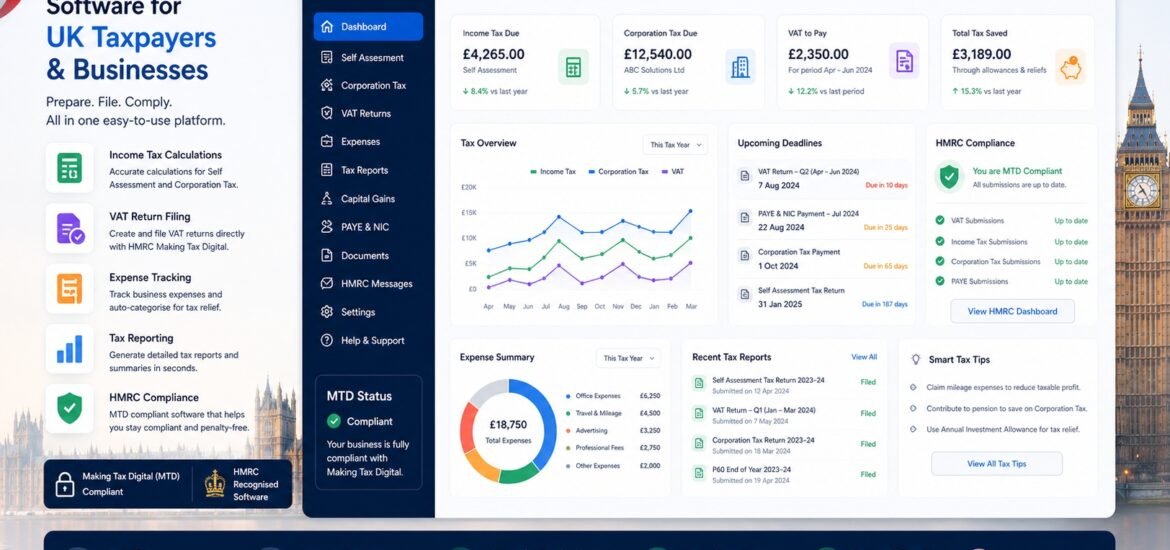
A practical guide to tax preparation software for UK taxpayers and businesses, covering VAT returns, self assessment, tax reporting, HMRC compliance, and expert tips to streamline tax filing and reduce errors.
Tax Preparation Software: A Complete Guide for UK Taxpayers and Businesses
Tax in the UK has quietly become a digital discipline. Paper returns are vanishing. Online filing is now the default for almost every type of return, from personal Self Assessment through to Corporation Tax CT600. Making Tax Digital is reshaping how sole traders and landlords report their income, and HMRC’s expectations on accuracy, timeliness, and audit trail are higher than they have ever been. Tax preparation software is no longer a convenience for the well organised. It is the way UK tax actually gets filed.
This guide explains what tax preparation software is, the main types available, the UK specific regulatory framework that shapes platform choice, and how to choose well whether you are filing your own Self Assessment for the first time or running a tax practice with hundreds of clients. It is written for a British audience and reflects the realities of the UK tax system in 2026.
The UK tax system rewards good records, punctual filing, and quiet, steady accuracy. Tax preparation software exists to make all three easier than the alternative.
What Is Tax Preparation Software?
Tax preparation software is the family of platforms that helps individuals, businesses, and tax professionals calculate, prepare, and submit tax returns to HMRC. It covers everything from consumer Self Assessment products aimed at first time filers through to specialist platforms used by tax advisers, in house tax teams in large corporates, and the accountancy profession.
Modern tax preparation software automates the heavy lifting of UK tax compliance. It applies current rates, allowances, and reliefs. It calculates tax liabilities accurately. It produces returns in HMRC’s required formats. It submits them digitally through HMRC’s APIs. And it stores the supporting records in line with HMRC’s retention requirements, so that any future enquiry can be answered with confidence rather than panic.
Why Tax Preparation Software Matters in the UK Today
The UK tax landscape has changed substantially over the past decade. Self Assessment returns are now overwhelmingly filed online, with paper returns surviving only at the margins. Corporation Tax has been digital first for years. VAT moved to Making Tax Digital in 2019, and the same principles are now being extended to Income Tax Self Assessment, with sole traders and landlords above defined thresholds being brought into MTD ITSA in phased waves.
At the same time, the rules themselves have grown more complex. Dividend allowances, the High Income Child Benefit Charge, IR35 and off payroll working, the trading and property allowances, the residence nil rate band for inheritance tax, and the tightening reporting requirements for capital gains on residential property have all added layers of detail to what used to be relatively straightforward situations. Tax law in the UK now changes meaningfully with every Budget and Finance Act.
Against this backdrop, tax preparation software is not just a productivity tool. It is the bridge between increasingly complex rules and the digital filing infrastructure that HMRC has built. For UK taxpayers and the professionals who serve them, choosing the right platform is one of the more consequential decisions in running their financial affairs.
Quick Navigation
Use the links below to jump straight to any section of this guide.
- Core Functions of Tax Preparation Software
- Types of Tax Preparation Software
- Who Uses Tax Preparation Software
- Key Features of Modern Tax Platforms
- UK Tax Regime Considerations
- Making Tax Digital and the Future of UK Tax Software
- Tax Preparation Software vs Accounting Software
- How It Connects to the Wider Finance Stack
- Comparison Table
- How to Choose Tax Preparation Software
- Common Questions
Core Functions of Tax Preparation Software
Although platforms vary in scope, most tax preparation software shares a common set of foundational capabilities that any UK user should expect.
Tax calculation
The core of any tax platform is the ability to calculate tax liabilities accurately under current UK rules. This includes Income Tax across the basic, higher, and additional rate bands, the Scottish and Welsh devolved rates where applicable, dividend tax, savings income, capital gains, Class 2 and Class 4 National Insurance for the self employed, and Corporation Tax for companies.
Form preparation
The software produces returns in HMRC’s required formats, including SA100 and its supporting pages for Self Assessment, CT600 for Corporation Tax, and the various supplementary schedules for property, foreign income, partnerships, and capital gains. Forms are populated directly from the underlying data rather than rekeyed manually.
Digital filing
Returns are submitted to HMRC electronically through the relevant APIs. For Self Assessment this means submission to the personal tax account infrastructure. For Corporation Tax it means submission alongside iXBRL tagged accounts. For VAT, it means submission through the Making Tax Digital VAT API.
Record keeping
Tax preparation software maintains the supporting records required under HMRC’s retention rules, typically for at least five years after the relevant filing date for individuals and six years for companies. This includes both the returns themselves and the underlying calculations and source data.
Allowances and reliefs
The software applies the correct personal allowances, dividend allowances, savings allowances, marriage allowance, and other reliefs available to the taxpayer. For businesses, it handles capital allowances, R&D relief, the Patent Box, EIS and SEIS related reporting, and the various sector specific reliefs that apply.
What if scenarios
Many platforms allow taxpayers and advisers to model the impact of different decisions, such as the timing of dividends, the use of pension contributions, or the realisation of capital gains, before they are made. This forward looking capability is increasingly important under a complex UK tax regime where small timing decisions can have meaningful consequences.
Integration with accounting data
Modern tax preparation software pulls data directly from accounting platforms rather than requiring manual entry. For sole traders and limited companies using cloud accounting, the underlying figures flow through to the relevant tax return automatically, dramatically reducing both effort and error rates.
Types of Tax Preparation Software
Within the broad tax preparation software category sit several distinct types, each suited to different taxpayers and use cases. The eight most important are explored below.
1. Self Assessment Software for Individuals
Self Assessment software is designed for individual UK taxpayers who must file an SA100 return, including high earners, those with multiple income sources, investors, and people with foreign income. These platforms guide the user through the various return sections, calculate the resulting liability, and submit the return directly to HMRC.
Consumer focused Self Assessment products typically take the user through a question and answer flow rather than presenting tax forms directly, which works well for first time filers and those with relatively straightforward affairs. More sophisticated platforms offer direct form view alongside guided flows, suiting those who prefer to see the underlying structure of the return.
2. Tax Software for Sole Traders and Landlords
Sole traders and landlords sit at the centre of one of the biggest changes in UK tax administration: the phased introduction of Making Tax Digital for Income Tax Self Assessment. Tax software in this category is built around the new MTD ITSA requirements, supporting digital record keeping, quarterly updates, and a final declaration in place of the traditional annual SA100.
For affected taxpayers, choosing MTD ITSA compatible software is increasingly non negotiable. Platforms in this category often combine bookkeeping with tax filing, since the same underlying records support both the quarterly updates and the final declaration. Many integrate with bank feeds and property management systems to capture rental income and expenses with minimal manual effort.
3. Corporation Tax Software for Limited Companies
UK limited companies must file a CT600 Corporation Tax return alongside their statutory accounts each year. Corporation Tax software supports the preparation and submission of CT600, including the iXBRL tagging of accounts that HMRC requires, the tax computation that translates accounting profit into taxable profit, and the submission of supporting documents.
For smaller companies, this functionality is often built into cloud accounting or company secretarial platforms. For larger companies, dedicated Corporation Tax software handles more complex situations such as group relief, transfer pricing adjustments, controlled foreign companies, and the diverted profits tax. The choice usually depends on the size and complexity of the company’s tax affairs.
4. Capital Gains Tax Software
Capital Gains Tax software supports the calculation and reporting of CGT liabilities arising from disposals of assets such as shares, property, and other investments. UK rules in this area have grown more demanding, particularly with the introduction of the 60 day reporting and payment requirement for residential property gains, which sits separately from the annual Self Assessment return.
For active investors and property owners, dedicated CGT functionality matters. Platforms in this category support share matching rules, principal private residence relief, lettings relief in its current narrower form, business asset disposal relief, and the various exemptions that affect the final liability. Many integrate with investment platforms and property management software to streamline data entry.
5. VAT and Indirect Tax Software
VAT software supports the calculation and submission of VAT returns under Making Tax Digital, alongside related indirect taxes such as the Plastic Packaging Tax, Climate Change Levy, and Customs Duty. For most UK businesses, VAT functionality is delivered through their accounting platform rather than as a separate product, which is why we cover this in more depth on the dedicated Accounting Software page.
For larger businesses with complex international operations, partial exemption calculations, or sector specific VAT issues, standalone indirect tax software offers additional depth. This includes determination engines for cross border transactions, tax engines that integrate with ERP systems, and reporting tools for multi country VAT compliance.
6. Tax Software for Accountants and Tax Practices
UK accounting and tax practices have their own specialist software needs. Practice focused tax platforms support the preparation and submission of returns for many clients efficiently, with shared client databases, agent authorisations to HMRC, document management, deadline tracking, and integration with the accounting platforms that clients themselves use.
Practice tax software typically handles the full range of UK tax returns, including Self Assessment, partnership, trust, Corporation Tax, and inheritance tax accounts. It also supports the workflow of client onboarding, anti money laundering checks, billing for tax work, and the multi step review processes that practices use to ensure quality before submission.
7. Specialist Tax Software
Some areas of UK tax are sufficiently specialised to support dedicated software. R&D tax relief platforms guide companies through identifying qualifying activities, calculating eligible expenditure, and producing the documentation required to support a claim. Patent Box software supports the more complex modular calculation introduced in recent years. EIS and SEIS focused platforms help companies and investors with compliance certificates and Self Assessment reporting. Inheritance Tax software supports the preparation of IHT400 and related forms for executors and advisers.
For taxpayers and businesses operating in these areas, specialist tools usually offer significantly better outcomes than trying to handle the same calculations within a generic tax platform.
8. Enterprise Tax and Compliance Software
Larger UK businesses, particularly multinationals, operate within a tax environment that goes far beyond traditional return preparation. Enterprise tax software supports global tax compliance, transfer pricing documentation, country by country reporting under OECD BEPS rules, the UK’s Pillar Two implementation through the Multinational Top up Tax and Domestic Top up Tax, tax provisioning under accounting standards, and tax data analytics.
This category often integrates directly with ERP systems, financial management platforms, and consolidation software, reflecting the way tax now sits as a discipline embedded across the wider finance function rather than as a separate annual exercise.
Who Uses Tax Preparation Software
Tax preparation software is used across virtually every part of the UK tax landscape, from individual taxpayers handling their own affairs through to multinational tax teams managing global compliance.
- Individual taxpayers: Use Self Assessment software to file their own SA100 returns, particularly those with relatively contained tax affairs who choose not to use an accountant.
- Sole traders and freelancers: Use tax software increasingly within an MTD ITSA framework, often integrated with bookkeeping tools.
- Landlords: Use property focused tax software that handles rental income, allowable expenses, mortgage interest restrictions, and capital gains on disposals.
- Limited company directors: Use Corporation Tax software for the company and Self Assessment software for their personal returns, since dividends, salary, and other income still flow through the personal tax system.
- Investors: Use Capital Gains Tax tools alongside platform statements to calculate gains correctly, particularly where share matching rules and reorganisations are involved.
- Trustees and executors: Use specialist tax software for trust and estate returns, including inheritance tax and complex income distributions.
- Accounting and tax practices: Use multi client platforms that handle the full range of UK returns across many clients efficiently and securely.
- In house tax teams: Use enterprise tax software for both UK and international compliance, alongside related provisioning, transfer pricing, and analytics tools.
Key Features Every Modern Tax Platform Should Have
Although the right software depends on the user, certain features have become baseline expectations for any modern tax preparation platform serving UK taxpayers.
- Full HMRC recognition for the relevant return types
- Direct digital submission to HMRC through the appropriate APIs
- Up to date application of current UK tax rates, allowances, and thresholds
- Support for the relevant devolved tax rules in Scotland and Wales
- Integration with accounting platforms and other source systems
- Clear audit trail of every calculation and supporting figure
- Support for HMRC’s retention requirements on records and returns
- Multi user access with role based permissions for practices and businesses
- Strong security including encryption, multi factor authentication, and UK GDPR compliance
- Helpful in product guidance that reflects current HMRC manuals and case law
- Ability to model the impact of decisions before commitment
- Annual updates that reflect each Budget and Finance Act in good time before relevant deadlines
UK Tax Regime Considerations
UK tax preparation software operates within a regulatory framework that is unusually detailed and updated frequently. Any platform used by a UK taxpayer must address the following.
Self Assessment
Self Assessment is the UK system through which individuals report income, gains, and other tax relevant matters not already collected through PAYE. Tax preparation software must support the SA100 main return and the supplementary pages for self employment, partnership income, property, foreign income, capital gains, and other categories that may apply.
Making Tax Digital for Income Tax Self Assessment
MTD ITSA is being phased in for sole traders and landlords above defined income thresholds. Affected taxpayers must keep digital records, submit quarterly updates, and complete a final declaration in place of the traditional annual return. Tax software must be MTD ITSA compatible to support those who fall within scope.
Corporation Tax
UK limited companies file CT600 Corporation Tax returns alongside iXBRL tagged accounts. Tax software must produce returns in the required formats, calculate the correct liability under current rates and reliefs, and submit the package digitally to HMRC. The introduction of the small profits rate and marginal relief has added complexity to the calculation in recent years.
Capital Gains Tax
CGT applies to disposals of assets above the annual exempt amount, with specific rates depending on the type of asset and the taxpayer’s overall income. Tax preparation software must handle the relevant share matching rules, available reliefs, and the separate 60 day reporting and payment regime for residential property gains.
Inheritance Tax
IHT applies to estates above the nil rate band, with an additional residence nil rate band where qualifying conditions are met. Specialist tax software supports executors and advisers in preparing IHT400 and related forms, alongside lifetime gifts and trust related calculations.
Reliefs and incentives
UK tax software should support major reliefs and incentives such as R&D tax relief, the Patent Box, EIS, SEIS, the Annual Investment Allowance, full expensing for qualifying capital expenditure, and the various sector specific reliefs for industries such as creative content production.
IR35 and off payroll working
For contractors operating through limited companies, IR35 affects the tax treatment of income from relevant engagements. Tax preparation software used in this context should support the correct treatment of deemed payments and the related reporting on both the company and personal returns.
UK GDPR and data protection
Tax data is among the most sensitive personal data any platform handles. UK GDPR and the Data Protection Act apply, requiring lawful processing, secure storage, access controls, and proper handling of data subject rights. Reputable tax platforms address this through encryption, role based access, audit trails, and clear data protection policies.
Making Tax Digital and the Future of UK Tax Software
Few developments have shaped UK tax software more profoundly than Making Tax Digital. The principle is straightforward: HMRC wants tax returns to be the natural output of digital records, rather than a separate exercise built on top of paper and spreadsheets. The implications run deep.
For VAT, Making Tax Digital has been in effect for several years. All VAT registered UK businesses must keep digital records and submit returns through MTD compatible software, rather than rekeying figures into HMRC’s online service. Tax software in this area is mature, widely available, and integrated into virtually every cloud accounting platform.
For Income Tax Self Assessment, the journey is well underway. Sole traders and landlords above defined income thresholds are being brought into MTD ITSA in phased waves, with quarterly updates and a final declaration replacing the traditional annual return. Tax software for this audience is evolving rapidly, with platforms competing to provide the smoothest possible experience under the new regime.
Corporation Tax has been digital first for years already, although MTD style quarterly reporting has not yet been extended to it. Many practitioners expect this to come in time, alongside continued tightening of the digital filing requirements for accounts and supporting documents.
The wider direction is unmistakable. UK tax is moving from periodic paper based returns to continuous digital reporting, and the tax software market is shifting with it. Choosing a platform built around this future is far wiser than choosing one rooted in the past.
Tax Preparation Software vs Accounting Software
This is a common point of confusion among UK taxpayers, and the distinction is worth setting out clearly.
Accounting software focuses on the day to day recording of financial transactions, the production of statutory accounts, and the management of business finances throughout the year. It produces the underlying figures, including the trial balance and the final accounts, that the tax return is built on.
Tax preparation software focuses specifically on producing and submitting tax returns. It takes accounting data, applies the relevant tax rules, calculates the liability, and submits the resulting return to HMRC. For some users, particularly individuals with no business, it works directly from personal income records rather than accounting data.
The two are complementary rather than alternatives. Most UK businesses use accounting software year round and tax preparation software at the relevant filing points. For sole traders and small companies, these capabilities are often delivered through a single platform that combines bookkeeping, statutory accounts, and tax filing. For larger and more complex situations, the two are usually separate but tightly integrated.
For more on the foundations, see our dedicated Accounting Software guide.
How Tax Preparation Software Connects to the Wider Finance Stack
Tax preparation software does not work in isolation. For most UK businesses and individuals, it sits at a particular point in the wider finance stack and connects with the systems around it.
Below it sit the systems of record. Accounting software produces the trial balance and management accounts that feed directly into Corporation Tax and Self Assessment computations for businesses. Payroll software generates the P60, P11D, and benefits data that feed into personal tax returns. Expense management software captures the deductible expenses that affect taxable profit.
For larger organisations, financial management software and ERP platforms support tax provisioning, group relief calculations, and the kind of structured reporting that tax teams rely on. Investment platforms feed CGT calculations directly into tax software for active investors. Property management systems provide the rental income and expenses needed for landlord returns.
Above it sit the consumers of the resulting filings: HMRC, of course, but also auditors, lenders, investors, and the various stakeholders who place weight on accurate and timely tax returns. For a complete view of how tax preparation software fits within the broader UK finance technology landscape, see our Business & Finance Software hub.
Comparison Table: Types of Tax Preparation Software at a Glance
The following table summarises the eight types of tax preparation software covered in this guide.
| Software Type | Primary Purpose | Typical UK User |
|---|---|---|
| Self Assessment Software for Individuals | File SA100 personal tax returns | Higher earners, investors, those with multiple income sources |
| Tax Software for Sole Traders and Landlords | Handle MTD ITSA quarterly updates and final declarations | Self employed, freelancers, residential and commercial landlords |
| Corporation Tax Software | Prepare and submit CT600 returns | UK limited companies of all sizes |
| Capital Gains Tax Software | Calculate and report CGT on disposals | Active investors and property owners |
| VAT and Indirect Tax Software | Handle VAT and related indirect taxes | VAT registered businesses, large corporates with complex VAT |
| Tax Software for Accountants | Manage tax work for many clients | UK accounting and tax practices |
| Specialist Tax Software | Handle R&D, Patent Box, EIS, SEIS, IHT | Innovating companies, executors, specialist advisers |
| Enterprise Tax and Compliance Software | Support global tax compliance and provisioning | Multinationals and large UK groups |
How to Choose Tax Preparation Software for a UK Taxpayer or Business
Selecting tax preparation software depends heavily on who you are and what you need to file. The following framework helps focus the decision on what matters most.
1. Confirm HMRC recognition for the relevant return types
Whatever you choose must be HMRC recognised for the specific returns you need to submit, whether that is SA100, CT600, MTD VAT, or MTD ITSA. This is non negotiable. HMRC publishes lists of recognised software for each return type that you can check directly.
2. Match the platform to your specific tax position
A consumer Self Assessment product is fine for someone with a salary, modest dividends, and rental income. It is not fine for someone running a complex partnership with foreign income and capital gains across multiple asset classes. Be honest about your tax complexity and choose a platform that comfortably handles it.
3. Integrate with your accounting and source data
Tax software is far more valuable when it pulls data directly from the systems where the underlying transactions live. For sole traders, that means bookkeeping integration. For limited companies, that means accounting integration. For investors, that means platform statement support. Manual rekeying is a sign of a platform that has not kept up with where the market has moved.
4. Consider whether you need professional support
Many UK taxpayers benefit more from paying a competent accountant than from buying their own tax software. Accountants typically already use practice tax software at a much higher level than consumer products, and they apply professional judgement to questions that DIY tools cannot easily handle. The right answer depends on the complexity of your affairs and your appetite for managing them yourself.
5. Plan for Making Tax Digital where it applies
If you are within scope of MTD VAT now or MTD ITSA in the near future, choose software that handles MTD natively rather than bolts it on. Platforms with strong MTD foundations will weather the further phases of MTD evolution far better than those still building it in.
6. Look at the total cost across the year
Annual subscriptions, additional fees for company returns, charges per submission, and the cost of supporting tools all matter. Cheap tax software that produces filing problems can easily cost more than premium alternatives that simply work. For practices, the total cost of running a tax suite includes both software and the time efficiency it delivers.
7. Test the experience with a real return
Most reputable tax platforms offer free trials or pay on submission models that let you build a full return before committing. Use this opportunity properly. A platform that feels confusing during preparation rarely becomes more comfortable at the moment of final submission, when the deadline is real and the room for error is small.
Common Questions About Tax Preparation Software
Is tax preparation software a legal requirement in the UK?
The software itself is not specifically required, but the digital submission of returns effectively requires some form of compatible product. Free filing options exist directly through HMRC for some return types, but most users find a commercial tax preparation platform more comfortable, more reliable, and better integrated with their wider records.
Can I file my own UK Self Assessment without an accountant?
Many UK taxpayers do file their own Self Assessment, particularly when their affairs are relatively straightforward. Modern Self Assessment software guides users through the process, applies current rules, and submits the return directly to HMRC. For more complex situations involving partnerships, foreign income, complicated capital gains, or significant business interests, professional advice usually pays for itself.
What is the difference between MTD compatible software and traditional tax software?
MTD compatible software is built around digital record keeping and direct submission to HMRC through the relevant APIs. Traditional tax software prepared returns that were submitted through online forms or attachments, which is increasingly being phased out for UK tax. For VAT and ITSA, MTD compatibility is becoming the only viable approach.
How much should a UK individual or business expect to pay for tax preparation software?
Consumer Self Assessment products typically cost from £20 to £80 for a single return, sometimes paid only on submission. Annual subscriptions for sole trader and landlord software under MTD ITSA generally range from £100 to £300 per year. Corporation Tax tools for limited companies often cost a similar amount, and practice grade tax suites for accountants run into thousands of pounds annually depending on volume and modules.
Is cloud based tax software safe for sensitive personal and financial data?
Reputable cloud tax platforms offer security that meets or exceeds what most users can implement themselves, including encryption, multi factor authentication, regular penetration testing, and certifications such as ISO 27001 and SOC 2. The most common security failures involve weak passwords, phishing, or sharing accounts inappropriately rather than the cloud model itself.
Can tax preparation software help me reduce my tax bill?
Tax preparation software calculates the correct liability under the rules. It can highlight reliefs and allowances you may not have used, and the better platforms include guidance about common opportunities. Genuine tax planning, however, usually benefits from professional advice that takes a wider view of your overall financial situation.
Do all UK landlords need MTD ITSA software?
Not yet, but the threshold is being lowered over time. Landlords above defined gross income thresholds are being brought into MTD ITSA in phased waves. Even for those still outside the scope, choosing software that supports the new regime now is a sensible way to be ready for the moment it applies.
What happens if I file my UK tax return late?
HMRC applies automatic penalties for late filing, starting at £100 immediately after the deadline and rising significantly for further delays. Interest is also charged on unpaid tax. Tax preparation software helps reduce this risk by tracking deadlines, prompting users in good time, and submitting returns electronically as soon as they are ready.
Final Thoughts on Tax Preparation Software for UK Users
Tax preparation software has moved from a back office tool used by professionals to a mainstream part of how UK individuals and businesses manage their tax affairs. The platforms covered in this guide handle one of the most regulated and frequently changing areas of UK administration, deliver the digital filing that HMRC now expects, and free taxpayers and advisers alike from the most repetitive parts of compliance.
Choose carefully, with HMRC recognition, MTD readiness, and integration potential at the front of your mind rather than the back. Match the platform to your real tax position, not the simplest version of it. Involve a professional adviser where complexity justifies it, and use software to make your annual obligations as smooth and accurate as possible. Done well, tax preparation software does exactly what good infrastructure should: keep you compliant, keep records audit ready, and keep tax in its proper place as one orderly part of running your financial life rather than an annual source of stress.
For more on how tax preparation software fits within the broader landscape of UK business and finance technology, return to the Business & Finance Software hub. For a wider view of every software category covered on this site, visit our main Softwares hub.