
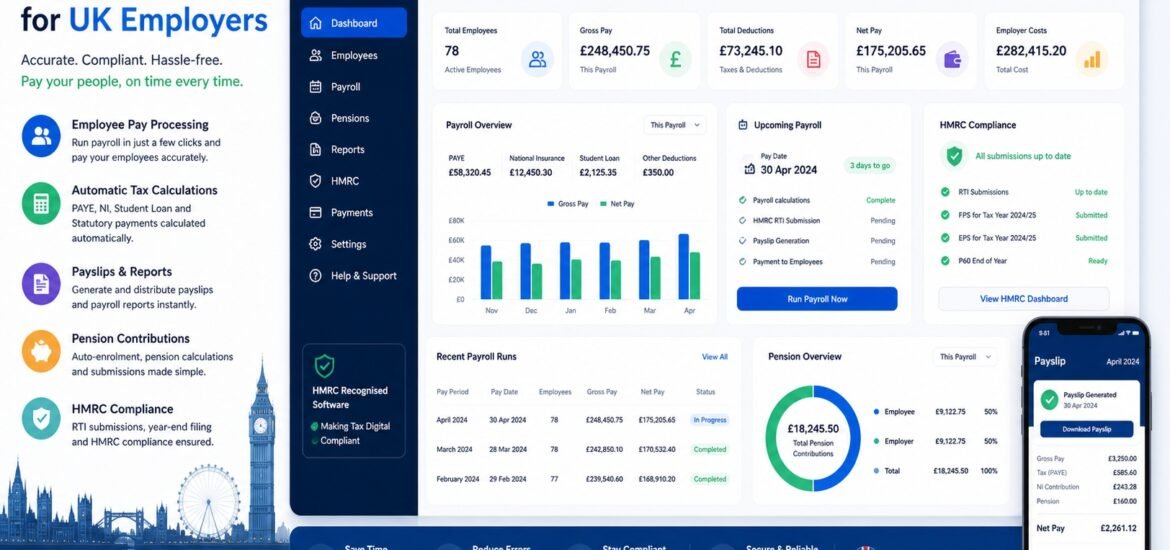
A practical guide to payroll software for UK employers, covering key features, PAYE and HMRC compliance, pension management, and expert tips to streamline payroll processes and ensure accurate employee payments.
Payroll Software: A Complete Guide for UK Employers
Few business systems carry as much weight, or as little tolerance for error, as payroll software. Wages must be calculated correctly, tax and National Insurance must reach HMRC on time, pensions must be deducted and submitted to the right scheme, and every employee must receive an accurate payslip. Get any of this wrong and the consequences are immediate: unhappy staff, HMRC penalties, pension regulator action, and reputational damage that no amount of public relations can quietly fix.
This guide explains what payroll software is, the main types available in the UK, the regulatory requirements every platform must meet, and how to choose well for your business size and complexity. It is written for a British audience and addresses the specific PAYE, National Insurance, pension auto enrolment, and employment law realities of running payroll in the UK in 2026.
Payroll is the only business process where every single employee notices, every single month, whether the software has done its job correctly.
What Is Payroll Software?
Payroll software is the family of platforms used by UK employers to calculate employee pay, deduct the correct tax and contributions, manage statutory payments, run pensions auto enrolment, and submit the resulting information to HMRC and pension providers. It replaces manual calculations, paper records, and spreadsheets with structured digital systems designed around the specific rules of UK tax and employment law.
Modern payroll software is overwhelmingly cloud based, runs Real Time Information submissions directly to HMRC after each pay run, integrates with accounting and HR systems, and provides employee self service for payslips and personal details. It is one of the most regulated and frequently updated software categories in any UK business, since the rules it must implement change with every Budget and Finance Act.
Why Payroll Software Matters in the UK Today
Running payroll in the UK is more demanding than in many comparable markets. Real Time Information requires submissions to HMRC on or before each payment date. Pension auto enrolment imposes legal duties on every employer, including running ongoing assessments and managing opt ins and opt outs. Statutory payments for sickness, maternity, paternity, adoption, and shared parental leave each have their own complex rules. Holiday pay calculations have shifted significantly under recent case law, particularly for workers with variable hours. The National Living Wage and National Minimum Wage rates change every April. The Construction Industry Scheme adds another layer for businesses paying subcontractors. IR35 and off payroll working continue to shape how contractors and intermediaries are paid.
On top of this, employees themselves expect more. They expect digital payslips, easy access to their P60s, transparent breakdowns of deductions, and the ability to update personal details without waiting for HR. They expect their pay to land in their account on the agreed date without exception, and they tend to notice immediately if anything is wrong.
Modern payroll software addresses all of this. It keeps pace with regulatory change, automates the routine calculations, gives employees the self service experience they expect, and provides employers with the audit trail they need when HMRC, the Pensions Regulator, or an employment tribunal asks questions. Trying to run UK payroll without proper software in 2026 is not just inefficient. It is, for any business beyond the smallest, genuinely risky.
Quick Navigation
Use the links below to jump straight to any section of this guide.
- Core Functions of Payroll Software
- Types of Payroll Software
- Who Uses Payroll Software
- Key Features of Modern Payroll Platforms
- UK Regulatory Requirements
- Payroll Software and HMRC Compliance
- Pension Auto Enrolment and Payroll Software
- Cloud Payroll vs Desktop Payroll
- How Payroll Software Connects to the Wider Stack
- Comparison Table
- How to Choose Payroll Software
- Common Questions
Core Functions of Payroll Software
Although platforms vary in scale and sophistication, most payroll software shares a common set of foundational capabilities that any UK employer should expect.
Pay calculation
The software calculates gross pay based on salary, hourly rates, overtime, bonuses, and commissions, then applies the correct deductions for PAYE, National Insurance, pensions, student loans, attachment of earnings orders, and any other deductions that apply. It accounts for tax codes issued by HMRC and updates them automatically as new codes are received.
Statutory payments
Payroll software handles the calculation of Statutory Sick Pay, Statutory Maternity Pay, Statutory Paternity Pay, Statutory Adoption Pay, Shared Parental Pay, and Parental Bereavement Pay, applying the relevant qualifying conditions and rates. It also handles eligibility checks and produces the necessary documentation for both employees and HMRC.
Real Time Information submissions
After each pay run, payroll software submits Full Payment Submissions to HMRC, plus Employer Payment Summaries where required. These submissions report what has been paid to whom and how much has been deducted, forming the backbone of the UK payroll compliance regime.
Pensions auto enrolment
The software performs ongoing assessments to determine which workers must be enrolled, calculates pension contributions on the appropriate qualifying earnings basis, processes opt ins and opt outs, and submits contribution files to the chosen pension provider.
Payslip generation
Itemised payslips are produced for every employee, showing gross pay, deductions, net pay, and year to date totals. Modern systems deliver these digitally through self service portals or email rather than printing them, while still allowing paper payslips for employees who prefer them.
Year end processing
At the end of each tax year, payroll software produces P60s for all employees in employment at year end, processes leavers with P45s during the year, and submits the final FPS for the year. It also handles benefits in kind reporting through P11D and the payrolling of benefits where applicable.
Reporting and audit trail
Payroll software produces management reports on pay costs, deductions, and absence, alongside a full audit trail of every change to employee records and pay calculations. This is essential for both internal control and external audit or HMRC inspection.
Types of Payroll Software
Within the broad payroll software category sit several distinct types, each suited to different scales and ways of working. The eight most important are explored below.
1. Cloud Payroll Software
Cloud payroll software is hosted by the vendor and accessed through a web browser or mobile app. It is the dominant model for new UK businesses today, offering automatic updates with each Budget and tax year change, real time collaboration between employers and external accountants, integrated employee self service, and access from anywhere.
Because UK payroll rules change frequently, the automatic update model of cloud payroll is particularly valuable. Tax thresholds, National Insurance rates, statutory payment levels, pension contribution thresholds, and student loan plan limits all change at least annually, and a cloud platform ensures these are reflected without any action by the employer.
2. Desktop Payroll Software
Desktop payroll software is installed and run on the employer’s own computer. It was the standard model for decades and is still used by some established UK businesses that prefer to keep payroll data on premises. Desktop platforms typically require manual updates each tax year, regular backups, and a single primary user, although some support local network access for small teams.
Desktop payroll remains viable for very small employers, particularly one director limited companies and family businesses with stable processes. For most growing UK organisations, however, the practical limitations and the steady regulatory drumbeat tilt the balance firmly toward cloud alternatives.
3. Integrated HR and Payroll Software
Integrated HR and payroll platforms combine payroll with broader human resources functions such as employee records, absence management, performance management, and recruitment. The single underlying employee record removes the need to maintain duplicate data between HR and payroll systems and makes processes such as new starters, leavers, and pay reviews dramatically smoother.
For UK employers in the ten to several hundred employee range, integrated HR and payroll has become the natural choice. It supports the volume of changes that an active workforce generates without requiring a finance team to act as the bridge between HR data and payroll calculations.
4. Bureau and Outsourced Payroll Software
Many UK businesses choose to outsource payroll entirely to an accountant or specialist payroll bureau. Bureau payroll software is designed for these providers, supporting multiple client payrolls, agent submissions to HMRC, secure client portals for approvals, and the workflow of running dozens or hundreds of payrolls each pay cycle.
For employers, the practical experience is that they provide pay information to their bureau, approve a payroll summary, and the bureau handles everything from RTI submissions to pension uploads. The right outsourcing choice for a small UK business is often a reputable bureau or accountant rather than running payroll software directly in house.
5. Specialist Payroll Software
Some UK sectors and pay arrangements have requirements that go beyond standard payroll software. The Construction Industry Scheme, with its specific rules on verifying subcontractors and applying the correct deduction rates, is one example. Umbrella company payroll, with its layered relationships between agencies, umbrellas, and end clients, is another. Contractor focused payroll, particularly around IR35 and off payroll working, is a third.
Specialist payroll software addresses these directly, often building on a standard payroll core and adding sector specific compliance and reporting. UK businesses operating in these areas usually find specialist tools much easier to live with than trying to bend a generic platform to fit their reality.
6. Enterprise Payroll Software
Larger UK organisations, particularly those with thousands of employees, multiple legal entities, or international operations, typically require enterprise payroll software. These platforms handle high volume processing, complex pay structures, sophisticated approvals, integration with ERP and HR systems, and detailed analytics across the workforce.
Enterprise payroll often forms part of a wider human capital management suite, sitting alongside HR, talent, and workforce planning modules. UK groups operating in multiple jurisdictions may also use country specific local engines connected to a global control layer that consolidates reporting across borders.
7. Self Service Payroll Software for Small Businesses
At the other end of the spectrum, self service payroll software is designed for very small UK employers, including one director limited companies, micro businesses, and family operations. It strips back complexity to the essentials: PAYE and National Insurance calculations, RTI submissions, payslips, and pension auto enrolment for the small number of employees involved.
For sole director limited companies running director only payroll, this category is often perfectly sufficient and very affordable. Many of these platforms cost less per month than a single hour of an accountant’s time and integrate cleanly with the employer’s accounting software.
8. Global Payroll Software
UK businesses with international operations face the challenge of running payroll across multiple jurisdictions, each with its own rules. Global payroll software addresses this by either providing local engines for each country or coordinating with local providers through a single platform that consolidates data centrally.
For UK based parent companies, the appeal is consistent visibility and reporting across the whole group, regardless of where employees are paid. The challenge is that local compliance still has to be handled correctly in each jurisdiction, and the quality of global platforms varies significantly in their depth of country specific support.
Who Uses Payroll Software
Payroll software is used across virtually every type of UK employer, with the right choice depending on size, structure, and complexity.
- One director limited companies: Run minimal payrolls, often through self service tools or as part of an accounting subscription that includes basic payroll.
- Small businesses with up to fifty employees: Typically use cloud payroll software, often integrated with their accounting platform, or outsource to a bureau.
- Mid sized businesses: Commonly use integrated HR and payroll platforms that handle the volume and complexity of a more active workforce.
- Larger employers: Usually run enterprise payroll software, often as part of a broader human capital management platform.
- Charities and not for profit organisations: Use either standard cloud payroll or sector aware platforms that handle elements such as Gift Aid related deductions and ecclesiastical exemptions where relevant.
- Construction businesses: Often combine standard payroll with specialist CIS modules to handle subcontractor payments correctly.
- Recruitment agencies and umbrella companies: Use payroll software designed for the layered employment models common in temporary staffing.
- Accountants and payroll bureaux: Use bureau focused platforms that allow them to run payroll for many clients efficiently and securely.
- Public sector and large employers: Often use enterprise platforms with deep integration to HR, finance, and operational systems.
Key Features Every Modern Payroll Platform Should Have
Although the right software depends on the employer, certain features have become baseline expectations for any modern payroll platform serving UK customers.
- Full HMRC recognition and direct RTI submission capability
- Automatic calculation of PAYE, National Insurance, student loans, and postgraduate loans
- Support for all current statutory payments and their qualifying conditions
- Pension auto enrolment assessments, contributions, and provider integrations
- Holiday pay calculations that reflect current case law for variable hours workers
- Year end processing including P60, P45, and P11D outputs
- Digital payslip delivery and employee self service
- Multi user access with role based permissions and audit trails
- Integration with accounting software for journal posting
- Integration with HR and time and attendance systems
- Strong security including encryption, multi factor authentication, and UK GDPR compliance
- Support for UK National Living Wage and National Minimum Wage checks
- Automatic updates aligned with each Budget and tax year change
UK Regulatory Requirements for Payroll Software
UK payroll software operates within one of the most detailed regulatory frameworks of any business system. Any platform used by a UK employer must address the following.
HMRC RTI submissions
Real Time Information requires employers to submit Full Payment Submissions to HMRC on or before each payment date and Employer Payment Summaries where applicable. Payroll software must be HMRC recognised and capable of producing and submitting these returns directly through the RTI gateway.
PAYE and tax codes
The software must apply the correct tax codes for each employee, process tax code notices issued by HMRC through the Data Provisioning Service, and handle the various code categories including emergency codes, week one or month one bases, and codes with prefixes such as K, S for Scottish taxpayers, and C for Welsh taxpayers.
National Insurance
Payroll software must calculate Class 1 National Insurance contributions for both employees and employers, applying the correct categories, thresholds, and rates. It should handle the various NI categories including A, B, C, H, J, M, V, X, and Z, and apply the appropriate treatment to directors who are subject to alternative calculation methods.
Pension auto enrolment
Under the Pensions Act 2008, every UK employer must operate auto enrolment. Payroll software supports this through ongoing worker assessments, contribution calculations on qualifying earnings, opt in and opt out processing, re enrolment cycles every three years, and submissions to pension providers in their required formats.
Statutory payments
The software must handle Statutory Sick Pay, Statutory Maternity Pay, Statutory Paternity Pay, Statutory Adoption Pay, Shared Parental Pay, and Parental Bereavement Pay. Each has its own qualifying conditions, payment periods, and rates that change at least annually.
Holiday pay
Recent UK case law has reshaped how holiday pay is calculated for workers with variable hours. Modern payroll software supports the calculation of holiday pay based on average earnings over the relevant reference period, currently fifty two weeks for many workers under amended Working Time Regulations.
National Living Wage and National Minimum Wage
UK employers must pay at least the National Living Wage or relevant Minimum Wage rate for the worker’s age band. Payroll software increasingly includes built in checks that flag pay rates falling below the relevant rate, helping employers identify breaches before they become enforcement actions.
Construction Industry Scheme
Construction businesses paying subcontractors must verify them with HMRC and apply the correct deduction rate, typically zero percent for gross status, twenty percent for registered, or thirty percent for unregistered subcontractors. Specialist payroll software supports verification, deductions, and the monthly CIS300 returns required by HMRC.
IR35 and off payroll working
For contractors operating through intermediaries, IR35 and off payroll working rules determine whether they should be treated as employees for tax purposes. Payroll software used in this context must support the calculation of deemed payments, manage the appropriate deductions, and produce the documentation needed by all parties.
UK GDPR and data protection
Payroll data is among the most sensitive personal data any UK business holds. UK GDPR and the Data Protection Act apply, requiring lawful processing, secure storage, access controls, and proper handling of data subject rights. Reputable payroll platforms address this through encryption, role based access, audit trails, and clear data protection policies.
Payroll Software and HMRC Compliance
HMRC publishes a list of payroll software products that have been tested against its specifications and are recognised for use with the PAYE Online service. UK employers should always check that their chosen platform appears on this list, since unrecognised software may produce submissions that HMRC cannot process correctly.
Beyond the recognition itself, UK payroll software supports HMRC compliance in several specific ways. It receives and applies tax code notices automatically through DPS, submits FPS and EPS returns on schedule, processes employer alignment submissions where required, and produces the year end information that HMRC needs to reconcile employer accounts. For employers using HMRC’s basic PAYE Tools, the limitations of that platform are increasingly visible as workforces grow, which is why most businesses move to dedicated payroll software once they have more than a small handful of employees.
Pension Auto Enrolment and Payroll Software
Auto enrolment is one of the most significant compliance burdens placed on UK employers, and payroll software does most of the heavy lifting. The platform should handle the assessment of every worker every pay period, classifying them as eligible jobholders, non eligible jobholders, or entitled workers, and triggering enrolment actions where appropriate.
Once workers are enrolled, the software calculates contributions on the qualifying earnings basis, set by the employer’s chosen scheme, applying current minimum contribution rates of three percent from the employer and five percent from the employee, with three percent of the employee contribution coming through tax relief in most cases. The contribution file is then submitted to the pension provider in their required format, whether that is Nest, The People’s Pension, Smart Pension, Aviva, Royal London, or another approved provider.
Beyond the regular cycle, payroll software manages opt in and opt out requests, refunds within statutory windows, postponement notices, and the three yearly re enrolment process. Every action is recorded for the Pensions Regulator’s purposes, since employers can be required to demonstrate compliance at any time.
Cloud Payroll vs Desktop Payroll Software
The shift from desktop to cloud payroll has been one of the defining trends in UK business software over the past decade. Both approaches still exist, but they suit very different circumstances.
Cloud payroll
Cloud payroll platforms run on the vendor’s servers and are accessed through a browser or mobile app. The main benefits include automatic updates with every Budget and tax year change, real time collaboration with accountants, integrated employee self service, secure offsite storage, and access from anywhere. They are the natural fit for almost every UK business today.
Desktop payroll
Desktop payroll software is installed locally on a user’s own computer. It can be appealing to businesses with strong preferences for local data control, those with unreliable internet connections, or those with very small, stable payrolls who have used the same platform for years. The trade offs include the burden of manual updates, more complex backups, harder collaboration with external accountants, and slower adaptation to regulatory change.
Hybrid arrangements
Some UK employers operate hybrid setups, with cloud payroll at the core and supplementary tools for specific tasks such as time and attendance or expense management. The key is to ensure that whatever combination is used, the system as a whole meets HMRC’s expectations on RTI submissions, pension regulator expectations on auto enrolment, and the employer’s own internal control needs.
How Payroll Software Connects to the Wider Finance and HR Stack
Payroll software rarely operates in isolation. It connects with both the finance and HR sides of the business in ways that fundamentally shape how efficiently the organisation runs.
On the finance side, payroll integrates with accounting software to post journal entries automatically after each pay run, ensuring that wages, employer NI, pensions, and statutory payments flow into the books without manual rekeying. It also connects to expense management software for reimbursements that need to flow through payroll, and to tax preparation software for year end and benefits in kind reporting.
On the HR side, payroll integrates with human resource management systems for the underlying employee record, with time and attendance systems for hours worked, and with absence management for sickness and leave that affects pay. For larger UK organisations, payroll often forms part of a broader human capital management platform that brings finance and HR together around a single source of employee truth.
For a complete view of how payroll fits within the broader UK technology landscape, see our Business & Finance Software hub and the related HR & Recruitment Software hub.
Comparison Table: Types of Payroll Software at a Glance
The following table summarises the eight types of payroll software covered in this guide.
| Payroll Software Type | Primary Strength | Typical UK User |
|---|---|---|
| Cloud Payroll | Automatic updates, easy collaboration, employee self service | Most UK businesses across size bands |
| Desktop Payroll | Local data control, offline operation | Established small businesses with stable processes |
| Integrated HR and Payroll | Single source of truth across HR and payroll | Mid sized UK employers and growing businesses |
| Bureau and Outsourced Payroll | Multi client management for accountants and bureaux | Accountants and payroll bureaux serving SMEs |
| Specialist Payroll | Sector specific features for CIS, umbrella, or contractor work | Construction firms, agencies, umbrella companies |
| Enterprise Payroll | High volume processing and deep integration | Large UK employers and groups |
| Self Service Payroll for Small Businesses | Affordable simplicity for very small payrolls | One director companies and micro businesses |
| Global Payroll | Multi country payroll coordination | UK based groups with international operations |
How to Choose Payroll Software for a UK Business
Selecting payroll software is one of the most consequential decisions any UK employer makes. The wrong choice creates years of compliance risk and operational pain. The right choice quietly disappears into the background of how the business runs.
1. Confirm HMRC recognition first
Whatever you consider must be HMRC recognised for RTI submissions. This is not negotiable. Anything else is a non starter, regardless of how attractive the rest of the proposition looks.
2. Match the platform to your size and complexity
One director limited companies need different software from a thirty person business, and a thirty person business needs different software from a multi entity group. Match the platform to where you actually are, with credible scope to grow into where you expect to be in two to three years.
3. Consider whether to run payroll in house or outsource
Many small UK businesses are better served by outsourcing payroll to an accountant or bureau than running their own software. The combination of regulatory complexity, occasional rule changes, and the consequences of mistakes often makes outsourcing more efficient and less risky than the apparent saving from doing it yourself.
4. Check sector specific support
If your business operates in construction, recruitment, umbrella employment, or any sector with payroll specialisms, confirm that the platform handles these natively. Workarounds in generic software tend to create problems at year end or during HMRC enquiries.
5. Evaluate the integration story
Payroll software is more valuable when it connects cleanly to your accounting platform, your HR system, your time and attendance tools, and your pension provider. Look for genuine integrations rather than CSV exports presented as connectivity.
6. Prioritise auto enrolment depth
Pension auto enrolment is one of the easiest places to get into trouble. Confirm that the platform handles ongoing assessments, opt ins and opt outs, re enrolment, and direct submission to your chosen pension provider in their required format.
7. Test the employee experience
Modern UK employees expect digital payslips, easy access to P60s, and the ability to update their personal details through self service. The quality of the employee facing experience is now part of how a payroll platform should be evaluated, not just the back office calculations.
8. Look at the long term total cost
Subscription fees are only part of the picture. Consider implementation effort, ongoing support, integration costs, and the time needed to manage the platform internally. Cheap payroll software that produces frequent compliance worries can easily cost more than premium alternatives that simply work.
Common Questions About Payroll Software
Is payroll software a legal requirement for UK employers?
Payroll software itself is not specifically required, but RTI submissions to HMRC effectively require some form of compatible software. Very small employers can use HMRC’s free Basic PAYE Tools, although it has notable limitations. Most UK employers move to dedicated payroll software once they have more than a small handful of employees.
Can I run payroll using a spreadsheet?
You can calculate pay using a spreadsheet, but you cannot submit RTI returns directly from one. Even very small UK employers therefore need at least HMRC’s Basic PAYE Tools or a recognised payroll product to complete the submission process. For most businesses, a proper payroll platform is much safer and more efficient than building from scratch.
What is the difference between payroll software and HR software?
Payroll software focuses on calculating pay, deductions, and statutory payments and submitting the relevant data to HMRC and pension providers. HR software focuses on the broader employee lifecycle, including onboarding, performance, absence, and learning. Many UK businesses now use integrated HR and payroll platforms that combine both.
How much should a UK business expect to pay for payroll software?
Cloud payroll subscriptions for UK small businesses typically range from around £5 to £30 per month for a small number of employees, plus a per employee fee at higher volumes. Mid market integrated HR and payroll platforms run from a few hundred to a few thousand pounds per month depending on headcount and modules. Enterprise payroll for large employers can be considerably more, often tens of thousands of pounds annually.
Should I run payroll in house or outsource it?
This depends on the size of your workforce, the complexity of your pay arrangements, and your appetite for managing compliance internally. Many small UK businesses outsource to a payroll bureau or accountant. Mid sized and larger employers more often run payroll in house with proper software, sometimes supported by external advice for unusual situations.
How does payroll software handle changes to tax codes during the year?
Reputable payroll software receives tax code notices automatically through HMRC’s Data Provisioning Service and applies them to the relevant employees in time for the next pay run. This removes the need to monitor HMRC’s online services manually for code changes, which would otherwise be a significant administrative burden.
What happens at the end of the UK tax year?
At the end of the tax year, payroll software produces P60s for all employees still in employment, submits the final FPS for the year, processes any necessary year end adjustments, and prepares for the new tax year by applying the updated thresholds and rates. Reputable platforms handle this transition smoothly with minimal user intervention.
Do I need separate software for pensions auto enrolment?
No. Modern UK payroll software handles auto enrolment as a built in capability, including ongoing assessments, contribution calculations, and submissions to the pension provider. Separate auto enrolment tools are only really needed if your payroll software has limited auto enrolment depth, which is increasingly rare.
Final Thoughts on Payroll Software for UK Employers
Payroll software has moved from a niche back office utility to a non negotiable foundation for any UK employer. The platforms covered in this guide handle compliance with one of the most demanding regulatory frameworks in the world, deliver the employee experience that modern workers expect, and free finance and HR teams from the kind of routine processing that used to consume entire days each month.
Choose carefully, with HMRC recognition, sector specific support, and integration potential at the front of your mind rather than the back. Match the platform to your real size and complexity, involve your accountant or bureau if appropriate, and remember that the cost of running payroll badly is always higher than the cost of running it well. Get those things right and your payroll software will quietly do exactly what good infrastructure should: support your people, keep regulators satisfied, and never give you a reason to think about it on a payday again.
For more on how payroll software fits within the broader landscape of UK business and finance technology, return to the Business & Finance Software hub or explore the related HR & Recruitment Software hub. For a wider view of every software category covered on this site, visit our main Softwares hub.