Search is no longer just about ranking blue links. With the rise of Google AI Overviews, ChatGPT, Gemini, Perplexity, and voice assistants, users are consuming answers—not webpages. This shift has fundamentally transformed how brands must optimize their content.
Traditional SEO is no longer sufficient on its own. Today, AEO (Answer Engine Optimization) and GEO (Generative Engine Optimization) are essential to ensure visibility, credibility, and discoverability across AI-driven platforms.
This guide explains how search optimization has evolved in the AI era—and how businesses can adapt to remain visible where decisions are now being made.
Understanding the Evolution of Search Optimization
Search optimization has evolved from simple keyword placement to a sophisticated ecosystem driven by artificial intelligence, user intent, and trust signals. What began as traditional SEO—focused on rankings and backlinks—has now expanded into answer-driven and generative experiences where visibility depends on clarity, authority, and contextual depth.
Modern search engines and AI systems no longer just index pages; they interpret meaning, evaluate expertise, and surface content they trust to answer real user questions. In this new landscape, brands that invest in BrandingX AI Authority Optimization Services position themselves not only to rank in search results, but to be recognized, referenced, and recommended across Google Discover, AI Overviews, and generative platforms where discovery now happens.
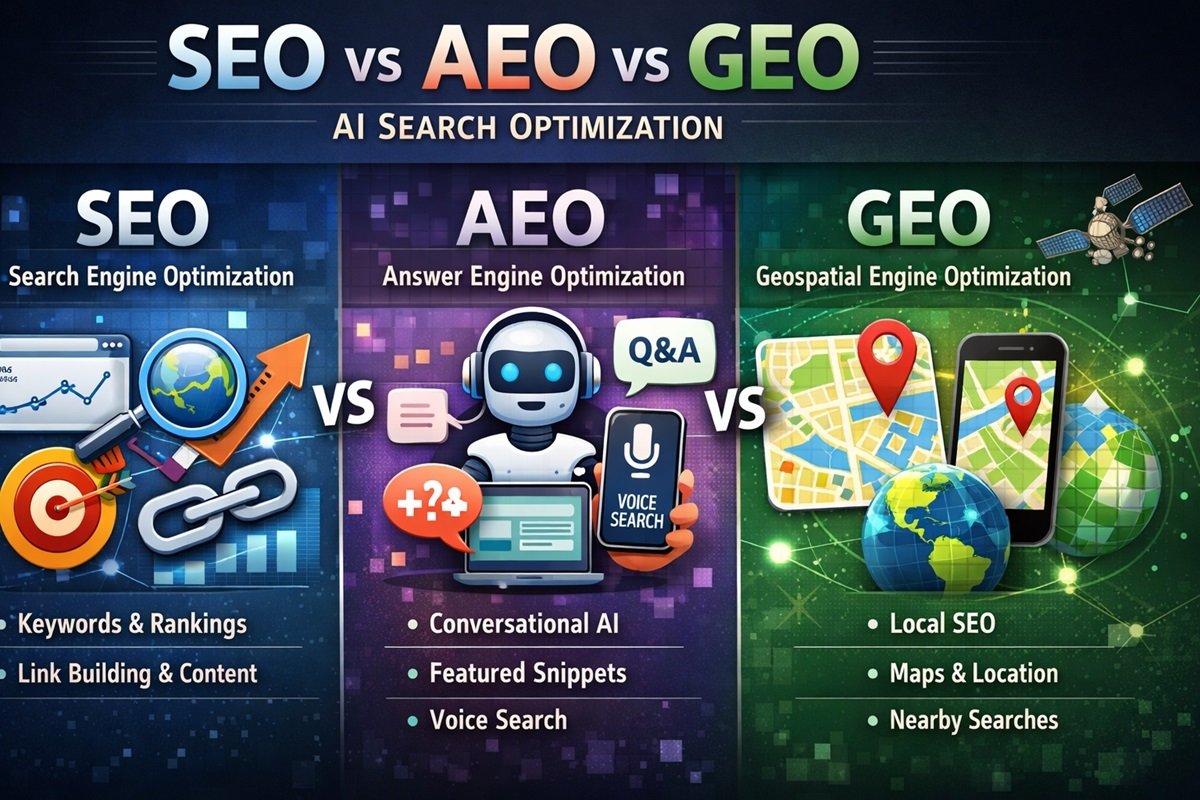
What Is SEO (Search Engine Optimization)?
SEO focuses on improving a website’s visibility in traditional search engine results pages (SERPs). It relies on:
- Keyword research and intent mapping
- On-page optimization (titles, headings, internal links)
- Technical SEO (page speed, mobile-friendliness, crawlability)
- Backlinks and domain authority
SEO remains critical, but its role has shifted. Ranking alone does not guarantee visibility when AI systems summarize or bypass links entirely.
What Is AEO (Answer Engine Optimization)?
AEO is the practice of optimizing content so that search engines and AI assistants can extract, understand, and directly present answers.
Key AEO characteristics:
- Clear, concise answers to specific questions
- FAQ-style formatting and structured data
- Conversational language aligned with voice and AI queries
- Content written for clarity, not just keywords
AEO determines whether your content becomes the answer, not just a result.
What Is GEO (Generative Engine Optimization)?
GEO is optimization for AI-driven generative platforms such as ChatGPT, Google AI Overviews, Gemini, Claude, and Perplexity.
GEO focuses on:
- Context-rich, authoritative content
- Entity clarity (brands, services, expertise)
- Topical depth rather than keyword density
- Trust signals that AI models rely on when selecting sources
If SEO is about ranking and AEO is about answering, GEO is about being cited, summarized, and trusted by AI systems.
Also Read: How a Generative AI Can Skyrocket Your Business Growth!
SEO vs AEO vs GEO: A Comparative View
| Aspect | SEO | AEO | GEO |
|---|---|---|---|
| Primary Goal | Rank in SERPs | Be the direct answer | Be referenced by AI |
| Optimization Target | Search engines | AI answer engines | Generative AI models |
| Content Style | Keyword-focused | Question-answer driven | Contextual, authoritative |
| Key Assets | Pages & links | FAQs, schema | Thought leadership |
| Visibility Outcome | Clicks | Zero-click answers | AI citations & summaries |
Why Traditional SEO Alone Is No Longer Enough
AI-powered search experiences often:
- Provide instant answers without clicks
- Combine insights from multiple sources
- Prioritize trusted, expert-level content
As a result, content that ranks but lacks clarity, depth, or authority may never be surfaced by AI systems, even if it appears on page one.
How AI Has Changed Search Behavior
Modern users now:
- Ask full questions instead of typing keywords
- Expect summarized, actionable answers
- Rely on AI for comparisons, recommendations, and decisions
This behavior shift requires content that is structured for understanding, not just indexing.
Also Read: How AI is Revolutionizing Digital Marketing
Building E-E-A-T in the AI Search Era
In the AI search era, visibility is earned through trust, not tactics. Search engines and generative AI systems increasingly evaluate content based on real experience, demonstrated expertise, and proven authority before deciding what to surface to users.
Building strong E-E-A-T now means going beyond keyword optimization to deliver first-hand insights, transparent authorship, and consistently reliable information. Brands that clearly communicate who they are, what they know, and why they can be trusted are far more likely to appear in AI Search Results, Google Discover, AI Overviews, and conversational AI responses—where credibility determines reach.
To succeed across SEO, AEO, and GEO, content must demonstrate:
Experience
- First-hand insights
- Practical examples
- Real-world use cases
Expertise
- Subject-matter depth
- Accurate, up-to-date information
- Clear explanations
Authoritativeness
- Consistent topical coverage
- Mentions, citations, and references
- Recognizable brand or author identity
Trustworthiness
- Transparent authorship
- Secure website (HTTPS)
- Honest, unbiased content
AI systems increasingly rely on these signals to determine which sources to trust.
Optimization Strategies That Work Across SEO, AEO, and GEO
1. Write for Questions, Not Just Keywords
Structure content around what users actually ask AI.
2. Use Clear Headings and Semantic Structure
AI models extract meaning from logical content hierarchies.
3. Add FAQ and HowTo Schema
Structured data improves machine readability and answer eligibility.
4. Build Topical Authority
Publish clusters of related, in-depth content instead of isolated posts.
5. Strengthen Brand Entity Signals
Consistent brand messaging across your site and authoritative platforms improves AI recognition.
The Future of Search Optimization
Search optimization is evolving into visibility engineering across human and machine audiences. Brands that adapt early to AEO and GEO will gain disproportionate exposure as AI becomes the primary interface for information discovery.
SEO is not dead—but it is no longer the finish line.
FAQs
What is the main difference between SEO, AEO, and GEO?
SEO focuses on ranking pages, AEO focuses on answering questions directly, and GEO focuses on making content usable and trustworthy for generative AI systems.
Is SEO still relevant in the AI era?
Yes, SEO remains foundational, but it must be complemented with AEO and GEO to maintain visibility in AI-driven search experiences.
How does AEO help with zero-click searches?
AEO structures content so search engines and AI tools can present your answers directly, even when users do not click through.
What platforms benefit most from GEO?
GEO benefits visibility in ChatGPT, Google AI Overviews, Gemini, Perplexity, and other generative AI interfaces.
How can businesses start optimizing for AI search?
By creating authoritative, well-structured content, using schema markup, answering real user questions, and strengthening E-E-A-T signals.
Author Bio:
Written by Sandeep Dharak, SEO & AI Search Strategist with hands-on experience in AI search visibility, AEO, and generative optimization.