
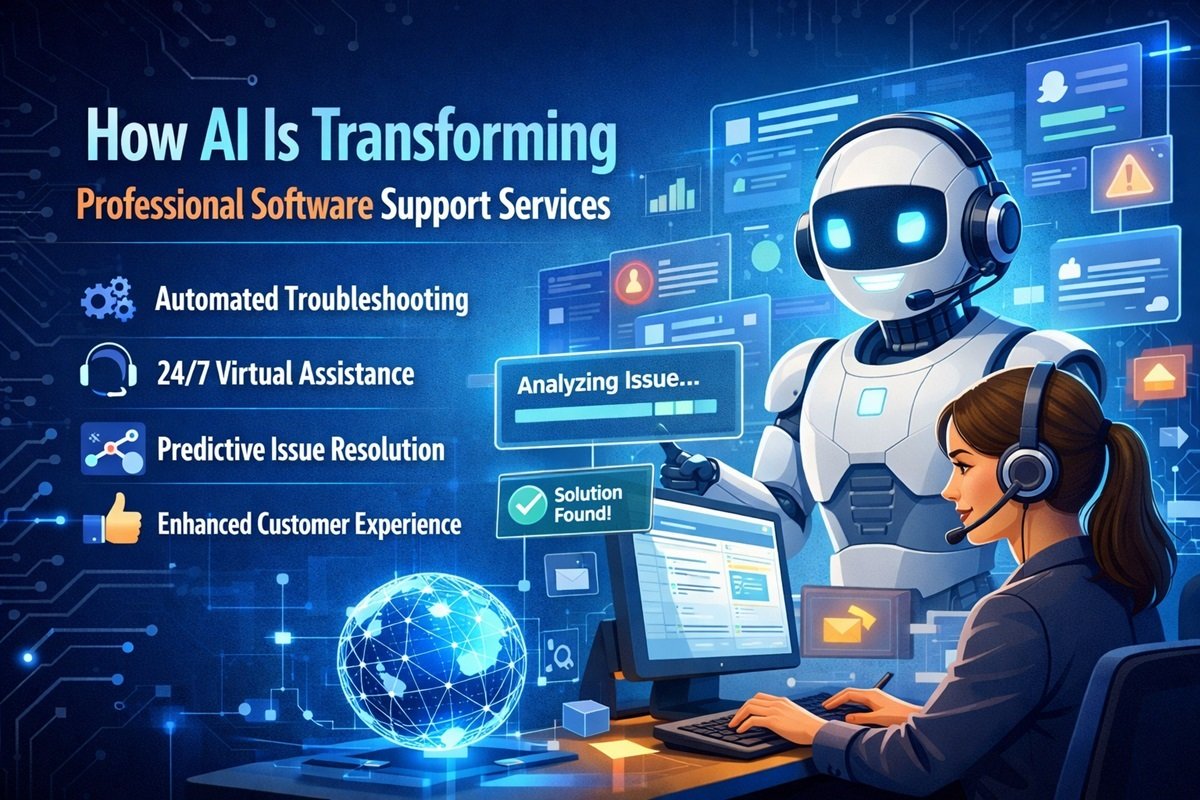
Professional software support services are under pressure to resolve issues faster, meet tighter SLAs, and support increasingly complex systems. Manual, ticket-heavy workflows struggle to scale with modern SaaS environments.
AI in professional software support services is changing this reality. By augmenting—not replacing—human agents, AI enables faster triage, better decision-making, and proactive incident prevention. This guide explains how AI is applied across ITIL-aligned support processes, where it delivers value, and where human oversight remains essential.
What AI in Professional Software Support Services Really Means
In an ITSM context, AI refers to machine learning and language models embedded into service desk workflows to assist with:
-
Ticket classification and routing
-
Knowledge discovery and recommendation
-
Pattern recognition across incidents and logs
-
Agent productivity and decision support
Unlike basic automation or scripts, AI systems learn from historical data and continuously improve outcomes when governed correctly. Most organizations deploy AI within existing ITSM tools rather than as standalone systems.
Traditional Support vs AI-Augmented Support
| Aspect | Traditional Support | AI-Augmented Support |
|---|---|---|
| Ticket intake | Manual categorization | Automated classification and prioritization |
| Resolution speed | Dependent on agent experience | Agent assist tools suggest next actions |
| SLA adherence | Reactive monitoring | SLA management automation with alerts |
| Knowledge usage | Static documentation | Knowledge base automation and gap detection |
| Incident prevention | After-the-fact | Predictive support analytics |
| Scalability | Linear with headcount | Scales with volume growth |
I-powered help desks do not remove human expertise; they amplify it by reducing repetitive cognitive work.
How AI-Enabled Support Works (Step-by-Step)
-
Ticket ingestion
Requests arrive via email, portal, chat, or API and are normalized. -
Support ticket triage automation
AI models classify issues by category, urgency, and impacted service using historical ticket data. -
Routing and prioritization
Tickets are automatically routed to the correct L1, L2, or L3 queue based on skills and SLAs. -
Agent assist tools
During investigation, AI suggests knowledge articles, similar incidents, and next-best actions. -
Resolution and validation
Human agents confirm fixes, ensuring accuracy and accountability. -
Continuous learning loop
Outcomes feed back into models to improve future recommendations.
This human-in-the-loop support design aligns with ITIL principles of accountability and continual improvement.
Use Cases Across L1, L2, and L3 Support
L1 Support Optimization
-
AI chatbots for technical support handle common queries such as password resets or configuration checks.
-
Multilingual support improves accessibility without expanding headcount.
L2 Support Optimization
-
Incident management AI correlates tickets with monitoring alerts.
-
Knowledge base automation drafts resolution steps and identifies outdated articles.
L3 Support Optimization
-
Root cause analysis automation identifies patterns across logs, metrics, and incidents.
-
Predictive analytics flag recurring issues before they escalate.
These use cases reduce mean time to resolution while preserving escalation paths.
Knowledge Base Automation and Self-Service at Scale
A frequent bottleneck in professional support services is outdated or incomplete documentation. AI improves knowledge management by:
-
Detecting duplicate or conflicting articles
-
Identifying gaps based on unresolved tickets
-
Assisting subject-matter experts in drafting accurate content
When integrated with ITSM platforms, this directly improves first-contact resolution rates and customer satisfaction.
Predictive Support Analytics and Proactive Incident Prevention
Predictive support analytics analyze trends across incidents, changes, and observability data. Common applications include:
-
Early detection of performance degradation
-
Capacity-related incident forecasting
-
Change-risk scoring during release cycles
While not perfectly predictive, these models enable support teams to act earlier, reducing business impact.
Risks, Compliance, and What AI Should NOT Do
AI adoption introduces non-trivial risks if poorly governed.
Key limitations and risks:
-
Hallucinated recommendations without validation
-
Bias from incomplete or skewed historical data
-
Prompt injection or data leakage if inputs are not controlled
What AI should not do:
-
Make final decisions on critical incidents without human approval
-
Access sensitive customer data without role-based controls
-
Operate without audit logging and traceability
Alignment with ISO/IEC 27001, SOC 2, and internal governance policies is mandatory for enterprise-grade support operations.
Implementation Roadmap for Businesses (30-60-90 Days)
Days 1–30: Foundation
-
Audit ticket data quality
-
Define success metrics and SLA goals
-
Identify low-risk automation candidates
Days 31–60: Pilot
-
Enable AI-assisted triage and routing
-
Deploy agent assist tools to a subset of teams
-
Establish QA sampling and feedback loops
Days 61–90: Scale
-
Expand to knowledge base automation
-
Integrate predictive analytics
-
Formalize AI governance and runbooks
This phased approach minimizes disruption while building confidence.
Metrics to Track (KPIs)
To measure value, organizations should track:
-
First-contact resolution rate
-
Mean time to resolution (MTTR)
-
SLA breach frequency
-
Agent utilization and burnout indicators
-
Customer satisfaction (CSAT)
KPIs must be reviewed alongside qualitative feedback to avoid over-optimization.
Conclusion: Turning AI Into a Competitive Support Advantage
AI in professional software support services is no longer experimental. When implemented with ITIL alignment, governance, and human oversight, it improves efficiency without sacrificing trust.
Next step: Start with AI-assisted triage and agent assist tools before expanding into predictive analytics. Incremental adoption delivers faster ROI with lower risk.
FAQs about How AI Is Transforming Professional Software Support Services
What is AI in professional software support services?
AI in professional software support services refers to using machine learning and language models to assist ticket triage, routing, knowledge discovery, and incident analysis while keeping humans accountable for decisions.
Can AI fully replace human support agents?
No. AI augments agents by handling repetitive tasks and surfacing insights. Complex troubleshooting, customer communication, and accountability still require human expertise.
How does AI improve SLA management?
SLA management automation monitors ticket priority, predicts breach risks, and alerts teams early, enabling proactive intervention rather than reactive escalation.
Is AI support compliant with data security standards?
It can be, if implemented with access controls, PII redaction, audit logging, and alignment to ISO 27001 and SOC 2 requirements.
What data is required to train support AI models?
Historical tickets, resolution notes, knowledge articles, and anonymized logs are commonly used, subject to privacy and governance policies.
How accurate are AI chatbots for technical support?
Accuracy depends on training data quality and human oversight. Most organizations restrict chatbots to low-risk L1 scenarios.
What governance controls are needed?
Policies for data usage, QA sampling, escalation thresholds, and regular model reviews are essential to prevent misuse and drift.
Does AI increase operational risk?
Poorly governed AI can increase risk. Controlled, phased deployment with human-in-the-loop design typically reduces operational risk.
People Also Ask
Q: How does AI help IT support teams work faster?
A: AI reduces manual effort by automating ticket classification, suggesting resolutions, and surfacing relevant knowledge, allowing agents to focus on complex issues.
Q: Is AI support suitable for SMBs?
A: Yes. Many SMBs adopt AI incrementally within existing ITSM tools, starting with triage and chat-based self-service.
Q: What is human-in-the-loop support?
A: It means AI assists decision-making, but humans approve actions, ensuring accuracy, accountability, and compliance.
Q: Can AI predict system outages?
A: Predictive analytics can identify patterns that indicate higher risk, but predictions are probabilistic, not guarantees.
Q: Does AI reduce support costs?
A: Often, by improving efficiency and reducing repeat incidents, though cost savings depend on proper implementation.
Q: What tools integrate AI into ITSM?
A: Platforms like ServiceNow, Jira Service Management, Zendesk, and Freshservice offer AI-assisted capabilities.
Q: How do you prevent AI hallucinations in support?
A: Restrict outputs to validated knowledge sources and require human confirmation for critical actions.
Q: Is AI support future-proof?
A: With ongoing governance and model updates, AI-enhanced support adapts better to evolving systems than static processes.
Also Read:
- Tekmetric: The Leading Automotive Repair Shop Management Software
- How AI Code Helpers are Revolutionizing Software Development
- How to Find the Best Custom ERP Software Development Services
Feel free to Write For Us and Contact Us for Branding, Web Design Services, Business Branding Services and SEO Services in Ahmedabad.


