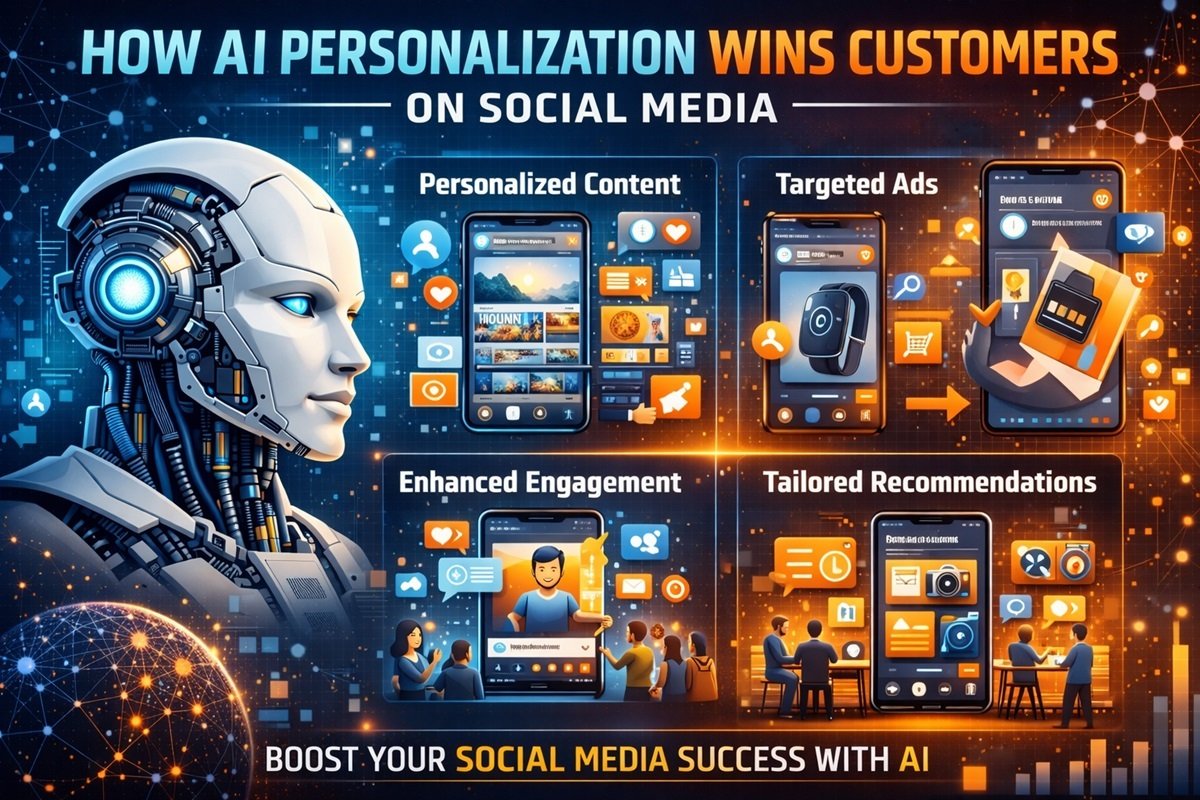
Social media doesn’t have an attention problem—it has a relevance problem. In 2026, customers scroll faster, ignore generic posts instantly, and trust only the brands that feel personal and timely. That’s why AI personalization has become the biggest competitive advantage in social media marketing. It helps businesses respond faster, reduce wasted ad spend, and deliver content that feels made for each customer—without needing a massive team.
In this guide, you’ll learn how AI personalization actually works, why it converts better than “one-size-fits-all” campaigns, and how to use it to win customers consistently.
What Is AI Personalization in Social Media Marketing?
AI personalization in social media marketing is the process of using artificial intelligence to tailor content, messages, offers, and experiences based on:
- user behavior (clicks, views, time spent)
- interests (topics and creators they engage with)
- intent signals (“I want to buy” vs “I’m just browsing”)
- past purchases or interactions
- demographics and location (when appropriate)
- engagement patterns (active times and preferred formats)
Instead of posting the same message for everyone, AI helps brands deliver the right content for the right person at the right time.
Why it matters in 2026
In 2026, social platforms reward relevance. Algorithms promote content that generates:
- watch time
- saves and shares
- meaningful comments
- repeat interactions
AI personalization increases these signals—because it makes content feel valuable.
Why AI Personalization Wins Customers (The Psychology Behind It)
Customers don’t buy because you posted more. They buy because:
- they felt understood
- you saved them time
- you reduced decision confusion
- you built trust quickly
AI personalization makes this easier by creating “micro-experiences” that match what each user needs.
The loyalty + conversion effect
When a customer sees content that feels designed for them:
- they engage more
- they revisit your profile
- they trust your brand
- they convert faster
Personalization doesn’t just increase clicks—it increases confidence.
9 Ways AI Personalization Wins Customers on Social Media
1) Personalization by Content Format (Not Just Topic)
Many brands only personalize topics—but in 2026, format preference matters just as much.
AI detects what users prefer:
- reels vs carousels vs static posts
- educational vs entertaining content
- short-form vs long-form video
- product demos vs testimonials
Use-case snippet
A skincare brand sees:
- Segment A saves ingredient breakdown carousels
- Segment B watches “routine” reels
- Segment C responds to before/after UGC
AI recommends a content mix based on format affinity.
Customer win: Less scrolling, faster decisions.
Brands can also scale personalized video content using AI avatars services for product explainers, onboarding clips, and regional messaging—without hiring creators for every variation.
2) Predictive Personalization (Serving What They Need Next)
AI can predict the next best content based on user behavior patterns.
It can forecast:
- who is ready to buy
- who needs education first
- who is close to unfollowing (churn risk)
- what objections exist (price, trust, delivery)
Example
If a user watches 3 product videos but doesn’t buy, AI triggers:
- a review post
- a comparison post
- a limited-time offer story
- a DM follow-up prompt (optional)
Customer win: Less uncertainty, more clarity.
3) AI Social Listening Personalization (Real-Time Relevance)
Social listening tools in 2026 don’t just track brand mentions—they detect intent and emotion.
AI identifies:
- complaints (service gaps)
- trending pain points in your niche
- competitor dissatisfaction opportunities
- high-performing topic patterns
Use-case snippet
Customers keep commenting:
“Is this safe for sensitive skin?”
AI suggests:
- a pinned post answering it
- a reel showing dermatologist-safe steps
- FAQ highlight updates
Customer win: Answers instantly available.
4) Personalized DM Journeys That Convert Without Pressure
DMs are the highest intent zone on social media. AI personalization makes DMs scalable, fast, and consistent.
What AI can personalize in DMs:
- greeting + tone
- product recommendation flow
- content suggestions (“watch this demo”)
- local delivery/time expectations
- FAQ responses (pricing, returns)
Example DM flow
User: “Which plan is best for beginners?”
AI: “If you’re starting, the Starter plan works best. Want a 30-second breakdown or feature comparison chart?”
Customer win: Faster purchase decisions.
5) AI-Powered Comment Replies That Feel 1:1
Comments influence buying decisions publicly. AI helps brands respond:
- faster
- more clearly
- in a consistent voice
- while linking relevant content
Smart personalization approach
Instead of replying “Thanks!”, reply like:
“Great question—if you want faster results, try the 7-day routine we shared in yesterday’s reel.”
Customer win: Instant help + confidence.
6) Personalized Offers Without Discount Addiction
The goal is not discounting—it’s relevance.
AI helps personalize offers like:
- bundle recommendations
- upsell to higher-value plan based on intent
- free trial for high-intent users
- education-first approach for cautious buyers
Use-case snippet (e-commerce)
Customer viewed “running shoes” 3 times.
AI suggests:
- shoe + socks bundle
- size guide + fit reel
- delivery guarantee note
Customer win: Better value with less effort.
7) AI Personalization for Social Ads (Savings + ROI)
Generic targeting wastes money. AI-driven ad personalization improves:
- creative matching by user segment
- lookalike refinement
- intent-based retargeting
- dynamic product ads (DPA)
- churn prevention ads
Stat-driven section: why personalization reduces ad waste
Personalized ads typically outperform generic ads because they:
- reduce irrelevant impressions
- improve click-through rates
- improve conversion rate
- lower cost per purchase over time
Even small improvements in CTR and conversion compound into significant cost savings.
Customer win: Better offers, less spammy ads.
8) Personalization Through UGC & Creator Content Matching
Customers trust creators more than brands.
AI helps identify:
- which creator content resonates with which audience
- which UGC should be boosted
- what testimonial type works best (price/value/results)
Use-case snippet
For premium customers, AI recommends:
“quality & durability” testimonials
For price-sensitive segments, AI recommends:
“value for money” reviews
Customer win: Proof that matches their buying mindset.
9) Post Timing Personalization (Right Message, Right Moment)
AI determines best timing by:
- segment activity windows
- platform-specific engagement peaks
- content type engagement timing
This improves reach without extra posting.
Customer win: They see your content when they’re actually ready to engage.
The Most Effective AI Personalization Framework (Simple Strategy)
Use this 5-step workflow:
Step 1: Collect intent signals
- saves
- profile visits
- DM activity
- watch time
- link clicks
Step 2: Segment into customer intent groups
- “Curious” (top of funnel)
- “Comparing”
- “Ready to buy”
- “Existing customer”
- “At-risk/churn”
Step 3: Create personalized content buckets
- quick how-to
- comparison and proof
- testimonials
- objection handling
- retention and onboarding tips
Step 4: Automate smartly (not blindly)
Use AI for:
- captions, hooks, variations
- reply suggestions
- FAQ responses
But keep humans for:
- escalations
- high-value customers
- sensitive issues
Step 5: Measure retention impact
Track:
- repeat engagement rate
- returning visitors
- DM conversion rate
- repeat purchases
- saves and shares (Discover-style signal)
Stat-Driven Section: What AI Personalization Improves (Real Outcomes)
AI personalization directly improves the drivers of conversion:
1) Engagement Rate
Relevant content leads to higher saves, shares, and comments.
2) Conversion Rate
Personalized proof + messaging reduces hesitation.
3) Time-to-Decision
Customers buy faster when answers are pre-built into your content ecosystem.
4) Customer Support Load
AI handles repetitive questions, saving team time.
5) Retention + Loyalty
Personalization makes customers feel valued, increasing long-term relationship strength.
Use-Case Snippets
Use Case 1: Fashion & D2C Brand
Goal: Increase repeat orders
AI personalization tactics:
- outfit recommendations by style preference
- reels by occasion (office, party, travel)
- DM size suggestions + delivery answers
Result: Higher trust + fewer returns
Use Case 2: Local Business (Gym / Clinic / Salon)
Goal: More recurring customers
AI personalization tactics:
- content based on problems (hairfall, weight loss, skin glow)
- reminder stories + DM follow-ups
- localized service highlights
Result: More walk-ins + repeat bookings
Use Case 3: SaaS / App
Goal: Reduce churn
AI personalization tactics:
- role-based content (marketer vs founder)
- feature-specific tutorial reels
- AI-assisted support replies
Result: Better onboarding + higher retention
AI Personalization Mistakes That Lose Customers
Even powerful personalization can backfire if it feels manipulative.
Common mistakes:
- overusing automation and sounding robotic
- recommending wrong products (bad data)
- too much “tracking vibe” (privacy discomfort)
- inconsistent brand voice across replies
- spamming DMs for conversions
Trust-first rule: Personalize to help, not to pressure.
People Also Ask (PAA)
What is AI personalization in social media marketing?
AI personalization is using AI to tailor social media content, ads, and customer interactions based on user behavior, intent, and interests to improve engagement and conversions.
How does AI help increase social media conversions?
AI increases conversions by predicting intent, delivering relevant content, improving ad targeting, and speeding up DM and comment responses.
Is AI personalization expensive for small businesses?
No. Small businesses can start with AI tools for content planning, caption writing, analytics insights, and DM automation without large budgets.
What is the biggest advantage of AI personalization in 2026?
The biggest advantage is delivering personalized experiences at scale—saving time, reducing ad waste, and increasing customer trust.
FAQs
How does AI personalization win customers on social media?
AI personalization wins customers by showing the right content, message, and offer based on user intent. It increases relevance, speeds up decisions, improves trust, and boosts conversions.
What are the best AI personalization strategies for social media?
The best strategies include intent-based segmentation, predictive content recommendations, AI social listening, personalized DM journeys, UGC matching, and automated engagement optimization.
Can AI personalization help build brand loyalty too?
Yes. AI personalization improves customer experience through faster replies, consistent messaging, and relevant content, which helps increase brand trust and loyalty over time.
Which social platforms benefit most from AI personalization?
Instagram, TikTok, YouTube Shorts, LinkedIn, and WhatsApp-based social support benefit most because these platforms reward relevance, speed, and high engagement.
Is AI personalization safe and ethical?
AI personalization is ethical when brands avoid invasive tracking, use minimal necessary data, keep transparency, ensure accuracy, and maintain human support for sensitive interactions.
What is AI personalization in simple words?
AI personalization means using AI to show people more relevant content and better recommendations based on what they like and need.
Why does AI personalization work on social media?
It works because it increases relevance, improves engagement, and helps users find solutions faster without wasting time on generic posts.
What is the fastest way to start AI personalization?
Start by segmenting your audience and creating content for different intents like beginners, buyers, and returning customers, then use AI tools to optimize hooks and messaging.
Does AI personalization require large data?
No. Even small businesses can personalize using basic signals like DM questions, post engagement, and audience responses.
Will AI replace social media marketers?
No. AI supports social media marketers by improving speed and scale, but human creativity, empathy, and brand strategy remain essential.
Conclusion: AI Personalization Is the Shortcut to Trust in 2026
In 2026, customers don’t want more content—they want better content. AI personalization wins customers because it makes every interaction feel relevant, fast, and valuable. Brands that master personalization will spend less, convert faster, and build stronger loyalty over time.
If you want to future-proof your social media growth, start with this:
- personalize by intent
- automate engagement smartly
- build trust-first experiences
- measure retention, not just likes
That’s how AI personalization wins—consistently.
Author Bio:
EtechSpider Editorial Team covers AI marketing, SEO trends, and modern digital growth strategies with a focus on practical implementation. Our articles are research-driven, regularly updated, and designed to help brands improve visibility, conversions, and customer experience across social media and AI-powered search platforms.